
Levelling refitted units at Porters Wood
Porters Wood sits about a mile north of the city centre and takes in the Gryphon Industrial Park, the Caxton Centre, Beech Industrial Centre and Spring Valley Business Centre. When a light industrial or hi-tech unit there is refitted, the floor finish usually changes too, and the existing slab or screed rarely meets the flatness the new finish asks for.
BS 8204 sorts floors into classes using a 2m straightedge: if nothing under it tops 3mm the floor is SR1, up to 5mm makes SR2, and up to 10mm SR3. SR1 is the class many thin sheet finishes demand, so vinyl and LVT in an office or clean production area usually need a levelling compound over the old base, not just a sweep and a primer.
Most compounds are poured somewhere between about 2mm and about 10mm thick, though a few products are made for more. Which primer we use depends on what lies underneath, since dense concrete, old sand and cement and calcium sulphate all want a different product, and getting it wrong lets the compound come loose. Old adhesive, paint and contamination come off first, often by grinding; our concrete floor grinding service handles that stage.
Where a unit floor is cracked, hollow or broken up, compound is the wrong answer, because deep pours to hide a failing floor can crack and debond. Those floors need repair first, and our commercial screeding service covers a new screed when the old one cannot be saved.
Joining old and new floors in St Albans homes
Homes built between 1945 and 1972 make up 27% of St Albans' housing, and a post-war floor has had decades to settle. When a new extension is added, its fresh screed rarely meets the old floor perfectly, and the join shows as a lip or a slope at the old back wall. Big tiles and click LVT will show up every lip and slope.
A skim of compound ties old and new together as one flat plane. We prime each base with the right product, feather the compound across the join and bring the whole room within tolerance, so the finish runs straight through without a threshold.
Then there are the solid floors in older houses. A sound but uneven floor in a pre-war house can often take a compound rather than a new screed. If it is damp, crumbling or hollow, though, the honest advice is to replace it, and our St Albans sand and cement screed page explains that route. For a thin coat over a small area, see latex screed. Sanding timber floorboards is outside our work, and we cannot advise on DIY products.
How we price floor levelling in St Albans
A fixed written price within 24 hours, once we know the area and the base. See our floor screeding cost guide.
Who levels your floor in St Albans
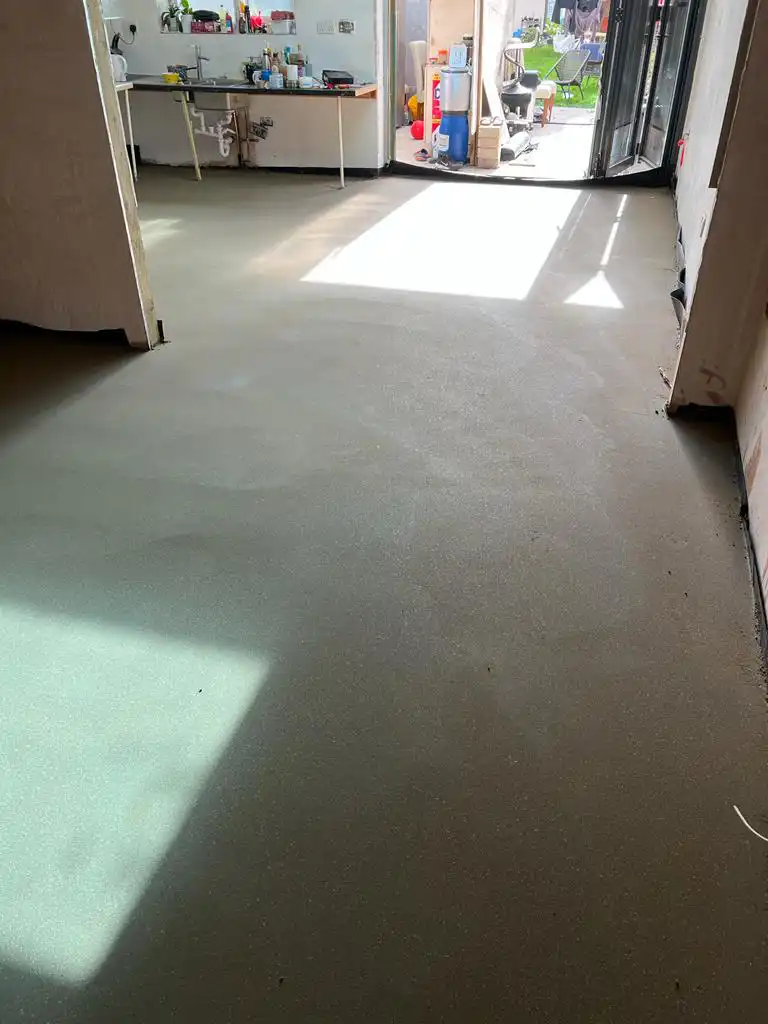
K & B Screeding’s own team, led by director Donatas Bardisevicius. Founded 2019, company 12298780.
See what customers say in our Google reviews and on our testimonials page.
Floor Levelling from Slough to St Albans
As the crow flies, our yard in Slough is about 20.1 miles from St Albans, which lies to the north-east. Postcodes here include AL3, AL4 and AL1, and Harpenden (4.5 miles), Hatfield (5.2 miles), Hemel Hempstead (5.7 miles) and Welwyn Garden City (6.7 miles) are close by.
More on floor levelling, part of our screeding services. Not sure whether you need a thin compound or a full flowing screed? See self levelling screed explained.
