
Rebuilding floors in Swanscombe's older houses
When an old solid floor fails, the signs are familiar: it dips along a wall, sounds hollow underfoot, or shows damp at the skirting. Patching rarely lasts. What lasts is taking the old slab out altogether, rebuilding the base from insulation plus a damp proof membrane, then screeding over it.
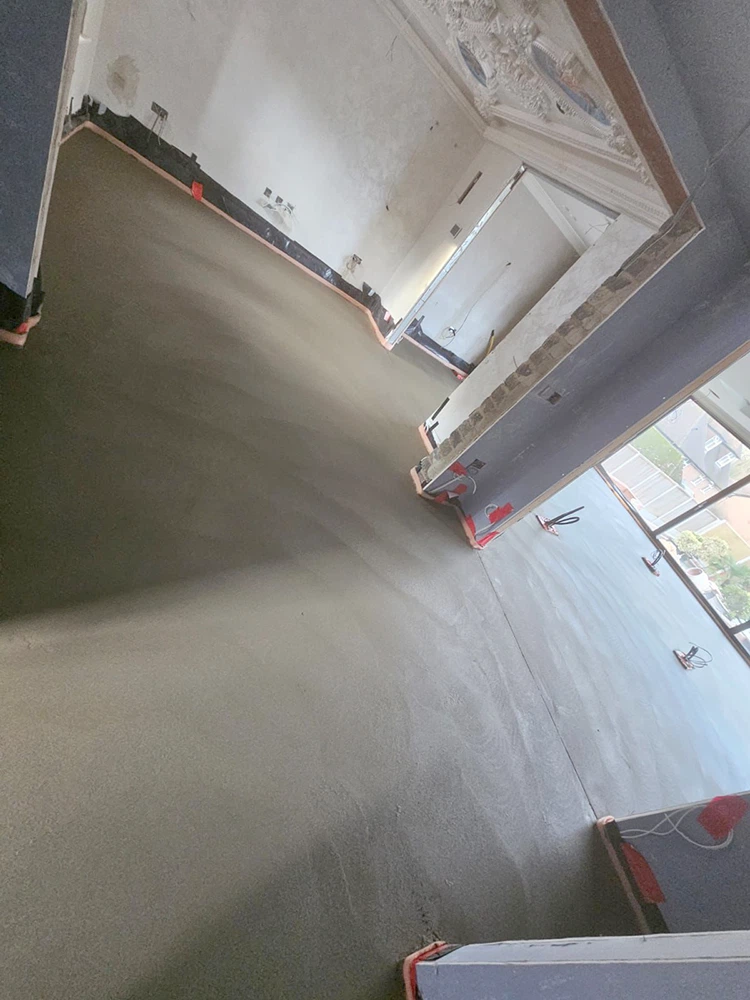
Hand-laid sand and cement is what we would use for that rebuild. Alongside the pre-1919 homes, another 9% date from between the wars, and houses of that age often have small rooms, narrow halls and uneven thresholds. A hand-laid screed can be stopped at a doorway, laid one room at a time, and ruled to meet the old floor level exactly.
It can go down one of two ways. Floating on insulation, it must be 65mm or more in a home and 75mm or more on a commercial floor. Bonded down onto concrete that is still sound, 25 to 40mm will do. Where only the top of an old slab has failed, a bonded screed can sometimes avoid a full dig-out.
Fibres stirred into the mix help it resist cracking and, on published figures, add £1 to £3 a square metre. It is worth it where a thin section or a varied depth is unavoidable, and our fibre reinforced screed page explains the option.
If the floor is sound but uneven, it may not need rebuilding at all; see levelling uneven floors in Swanscombe.
Swanscombe wet rooms, garages and early loading
Wet rooms are a natural fit for sand and cement. A level-access shower depends on the floor sloping to its drain, and screed laid by hand can be formed to that slope. The cement surface it leaves is what tanking kits and tile adhesives expect, and water does it no harm, unlike calcium sulphate.
Garages are another. Garages tend to sit a step down from the house, so converting one means raising the floor with insulation and screed until it lines up with the hall. For the depth of each layer, open garage conversion floors.
Sand and cement also suits floors that need a cement substrate or have to take load sooner, such as a workshop area or a floor under heavy units.
The drawback is drying. Its water leaves at roughly a millimetre a day through the first 40mm and more slowly below that, so vinyl or wood on a 65mm floor is several weeks off. On published 2026 UK figures it costs £18 to £25 a square metre. When dates are tight, a faster drying mix cuts down the wait. The hand-laid service extends to nearby Gravesend as well.
Sand and Cement Screed prices in Swanscombe
Sand and cement screed: £18 to £25 per m² supplied and laid (MyJobQuote, August 2026), so £450 to £630 for 25 m². MyJobQuote does not say whether these figures include VAT. See our floor screeding cost guide or screed calculator.
Who lays your sand and cement screed in Swanscombe
K & B Screeding’s own team, led by director Donatas Bardisevicius. Founded 2019, company 12298780.
See what customers say in our Google reviews and on our testimonials page.
Sand and Cement Screed from Slough to Swanscombe
As the crow flies, our yard in Slough is about 40.5 miles from Swanscombe, which lies to the east. Postcodes here include DA9, and Dartford (1.6 miles), Grays (2.6 miles), Northfleet (2.8 miles) and Tilbury (3.5 miles) are close by.
More on sand & cement screed, part of our screeding services.