
Where liquid screed fits Canterbury's newer homes
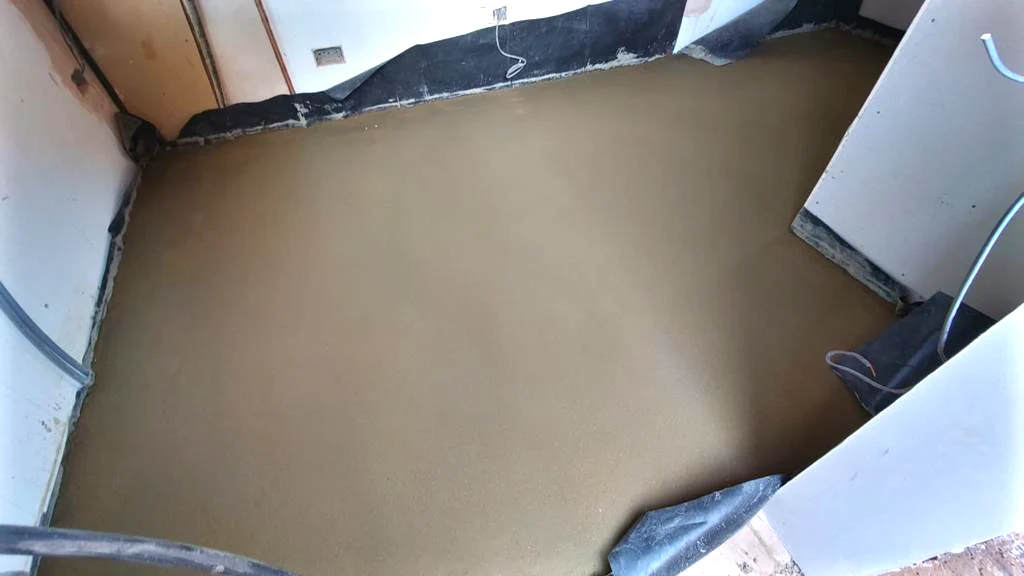
The screed turns up already mixed, and a hose carries it from the mixer straight onto the insulation boards. It finds its own level, so a wide floor is covered in a single day with no hand compaction. Both calcium sulphate and cement based versions exist, and the choice between them depends on the specification and on whether the room may get wet.
It suits large, simple floors. A rear extension that opens the kitchen into the garden, a ground floor knocked through into one room, or a new-build plot with insulation laid wall to wall are all good fits. Purpose-built blocks account for 25% of Canterbury's homes, and apartment floors, poured room after room in one visit, are natural candidates too.
How thick the floor goes is a decision in its own right. Laid floating, a house floor in liquid screed needs only about 35mm and a commercial one around 40mm, while traditional sand and cement asks for 65mm. That saved height can make the difference where a new floor has to meet an existing threshold.
Flatness is the other gain. Run a 2m straightedge over it and SR1 means no gap past 3mm, SR2 no gap past 5mm; liquid screed reaches either class readily. Floors that flat take LVT, big format tiles or engineered boards without fuss. Because it shrinks so little, it also needs fewer joints than a screed laid by hand. For the difference in cost and drying, read liquid screed vs sand and cement.
Getting the pump to a Canterbury floor
Every liquid pour depends on access. The mixer or pump sits at the kerb and a hose runs through the house to the room, so before pricing we ask where a vehicle can stop, how long the hose run is and whether the floor is upstairs. For a flat above ground level, the hose goes up through the communal stairs or in at a window.
In the walled centre and on Wincheap's terraced streets, parking is the first thing to settle. It may mean a booked space or an early start, and it is better agreed when the job is priced. Elsewhere in the city, from Hales Place and Scotland Hills to Thanington, the questions are the same: where the vehicle stands and how far the hose travels to reach the floor.
People can cross it within 24 to 48 hours. Flooring is another matter: a 40mm depth needs something like 40 days, and each extra millimetre beyond that takes longer again. Where the pumping is the service you need, see our screed pumping service. If the extension will have heating pipes, our page on underfloor heating screed in Canterbury covers pipe cover and commissioning. Whitstable, about 6 miles away, has its own page on liquid screed for Whitstable homes.
Liquid Screed prices in Canterbury
Liquid screed: £24 to £31 per m² supplied and laid (MyJobQuote, August 2026), so £960 to £1,240 for 40 m². MyJobQuote does not say whether these figures include VAT. See our floor screeding cost guide or screed calculator.
Who lays your liquid screed in Canterbury
K & B Screeding’s own team, led by director Donatas Bardisevicius. Founded 2019, company 12298780.
See what customers say in our Google reviews and on our testimonials page.
Liquid Screed from Slough to Canterbury
On the map, Canterbury sits east-south-east of Slough, about 76.5 miles from our base in a straight line (postcodes including CT1, CT2 and CT3), next to Whitstable (5.9 miles), Herne Bay (6.7 miles), Faversham (8.5 miles) and Ashford (12.8 miles).
More on liquid screed, part of our screeding services.
