
Thanet Way and Ridgeway plots, poured phase by phase
On a housing site, speed and repeatability matter as much as the floor itself. Liquid screed is pumped into each plot through a hose from a mixer parked on the site road, so a whole ground floor is laid in a single visit and the crew moves on to the next plot. It flows around pipework, finds its own level and reaches SR1 or SR2 flatness readily, which saves preparation work for the flooring trades later on.
It also shrinks very little. Open-plan ground floors with kitchen, dining and living space in one run can be poured with far fewer joints than sand and cement would need, and that suits large tiles and wide boards.
It is also thinner. Laid floating in a home, a pumped floor needs from about 35mm, where a hand-laid one would be about 65mm. On a new plot that frees up space for thicker insulation under the same finished floor level.
Some 17% of Whitstable's homes were built from 2000 onwards, so the newer stock is growing but still the minority. The planned 400 homes off Thanet Way and 300 south of Ridgeway will add to it.
What binds a pumped screed is either calcium sulphate or cement. Developers working to a named calcium sulphate grade will find the detail on our anhydrite flow screed specifications page, and our screed pumping service explains the kit.
Extensions and flats around Whitstable
Away from the new sites, liquid screed earns its place in the rear extensions added to inter-war and post-war family houses. A new insulated slab at the back, often with heating pipes on it, needs a screed that finishes flat against the old floor. A flowing screed does that in one visit.
Flats are another fit. They make up 13% of Whitstable homes, and on an upper floor a pump hose running up the stairwell saves hours of carrying heavy sand and cement.
The pump itself has to stand outside, within reach of a door. Detached houses in Chestfield or Tankerton with their own drive give it an obvious spot. In the tighter streets and alleys of the centre, tell us where it could stand and whether there are parking limits.
The room must be ready before we arrive: edge strip on every wall, membrane taped at every joint and doorways dammed. Being able to cross it within 48 hours does not make it ready for tiles or boards; our guide to how long screed takes to dry sets out why.
Liquid Screed prices in Whitstable
Liquid screed: £24 to £31 per m² supplied and laid (MyJobQuote, August 2026), so £960 to £1,240 for 40 m². MyJobQuote does not say whether these figures include VAT. See our floor screeding cost guide or screed calculator.
Who lays your liquid screed in Whitstable
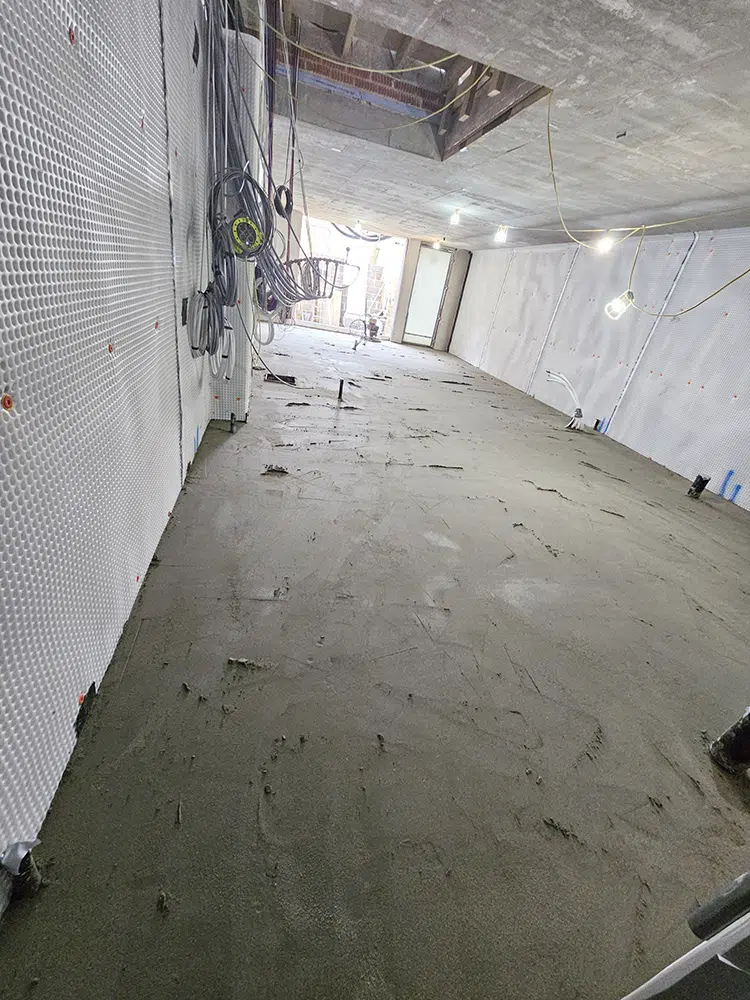
K & B Screeding’s own team, led by director Donatas Bardisevicius. Founded 2019, company 12298780.
See what customers say in our Google reviews and on our testimonials page.
Liquid Screed from Slough to Whitstable
As the crow flies, our yard in Slough is about 73.1 miles from Whitstable, which lies to the east. Postcodes here include CT5, and Herne Bay (4.5 miles), Canterbury (5.9 miles), Faversham (6.5 miles) and Sittingbourne (12.6 miles) are close by.
More on liquid screed, part of our screeding services.
