
Heated extensions on Whitstable family houses
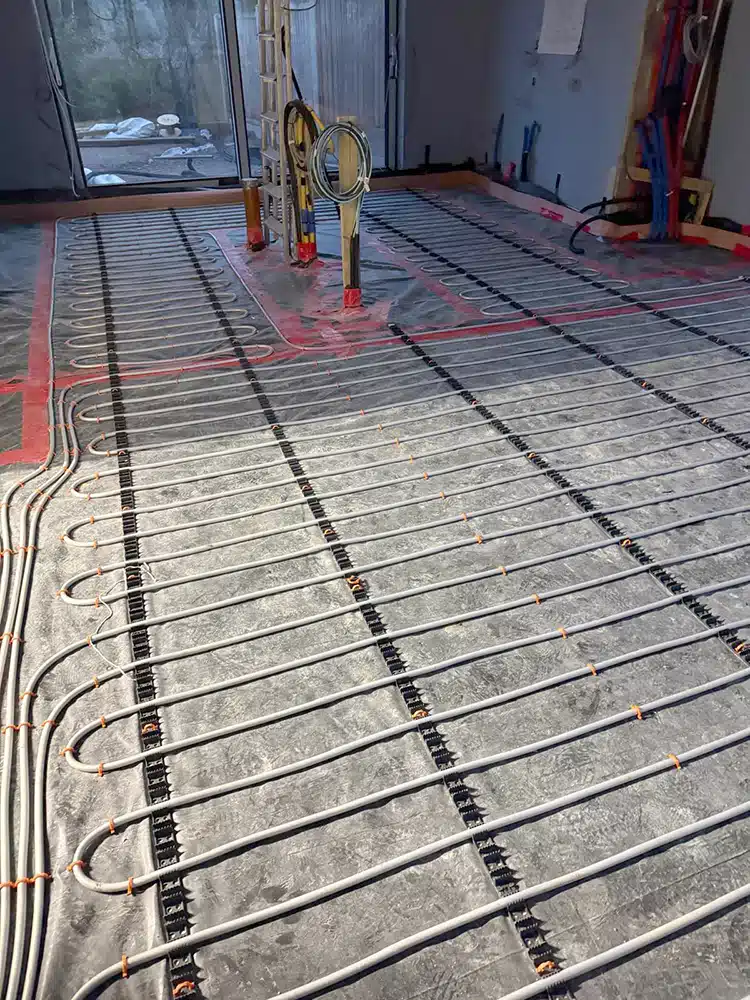
The classic project here is a single storey extension on a detached or semi-detached house, opening the back of the home into one heated kitchen and living space. The new floor is an insulated slab with heating pipes clipped to it, and the screed laid on top does two things: it protects the pipes and spreads the heat evenly.
Getting the cover right is the key detail. Poured screed has to sit no less than 25mm above the top of the pipes, which brings the floor to 45 to 50mm overall. Hand-laid screed wants roughly 45mm over them, so that build-up is deeper. Thin cover can crack along pipe runs; very thick cover makes the floor slow to warm.
A pumped screed closes round each loop without leaving trapped air, and that is the main reason heated kitchens tend to get one. Sand and cement works where a cement base is needed, but must be compacted carefully around the pipes.
Homes built between the wars account for 19% of Whitstable's housing, and houses of that age are often extended in just the same way, with a heated kitchen at the back. The existing floor in the older part of the house may need insulating too if the heating is to run through; our membranes and insulation work covers that. As a price guide, a heated floor in liquid screed comes in at £20 to £35 per m² on published UK figures.
Commissioning a heated floor in Whitstable
Before the screed goes in, the heating engineer should pressure test the circuit and leave it under pressure during the pour. We then check the insulation, the membrane and the perimeter strip, because a floating screed needs all three to behave.
After the pour comes the heat-up. With calcium sulphate, the system can normally be run from around a week after pouring. With sand and cement, hold off for three weeks at the very least, so 21 days. Whichever you have, nudge the flow temperature up in small steps across several days, following the written plan we leave. Crank it to full straight away and the floor dries too quickly and may crack.
The heating can then help the floor reach the moisture level the flooring needs, which is especially useful with tiles or engineered wood. For how long each screed takes to dry, see the screed drying guide.
If the plan is a retrofit into an older house instead of an extension, floor height is usually the limit, and a thinner liquid screed over new pipes can save space compared with sand and cement.
Underfloor Heating Screed prices in Whitstable
Liquid screed over underfloor heating: £20 to £35 per m² supplied and laid (trade2base, June 2026), so £700 to £1,230 for 35 m². trade2base gives these figures excluding VAT. See our floor screeding cost guide or screed calculator.
Who lays your underfloor heating screed in Whitstable
K & B Screeding’s own team, led by director Donatas Bardisevicius. Founded 2019, company 12298780.
See what customers say in our Google reviews and on our testimonials page.
Underfloor Heating Screed from Slough to Whitstable
As the crow flies, our yard in Slough is about 73.1 miles from Whitstable, which lies to the east. Postcodes here include CT5, and Herne Bay (4.5 miles), Canterbury (5.9 miles), Faversham (6.5 miles) and Sittingbourne (12.6 miles) are close by.
More on underfloor heating screed, part of our screeding services.
