
Fitting heated floors into older Canterbury rooms
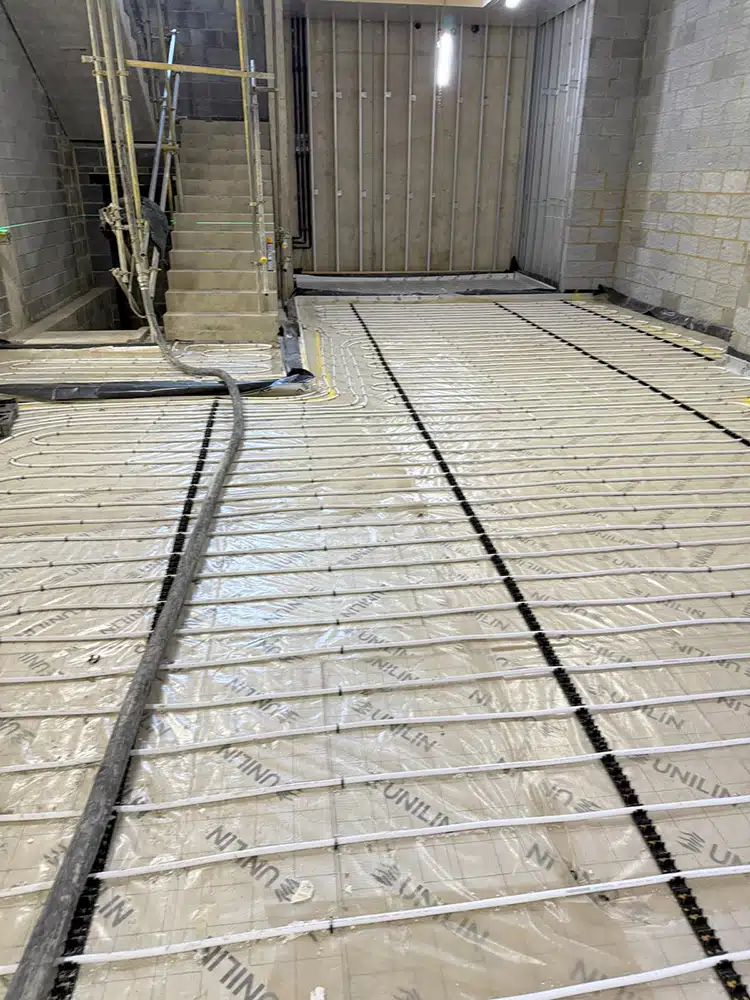
Pipes under a floor heat the room only as effectively as the screed packed around them allows. The pipes have to be fully encapsulated with no air pockets, and the cover above them has to be deep enough for strength and even heat spread. Liquid screed has to sit at least 25mm proud of the pipes, which typically makes the layer 45 to 50mm thick. With sand and cement the cover goes up to roughly 45mm, so the build-up as a whole gets deeper.
In a new extension that depth is designed in. A retrofit is harder. Semis make up 30% of Canterbury's homes, and when one of them has its kitchen floor dug out for heating, the insulation, pipes and screed all have to fit between the new slab and the existing finished floor level. Liquid screed is often chosen here because it needs less cover and so saves height.
In listed and conservation area buildings inside and just outside the city walls, a heated floor raises bigger questions. Those buildings typically need breathable build-ups and thin levelling, so a standard insulated screed may not be appropriate, and the approach must be agreed before anything is ordered.
Before the pour we inspect the edge strip, the membrane and the insulation, and supply any that are not already down. The strip around the room's edges gives the screed space to grow as it heats up. Read the screed thickness guide for depths across different build-ups, and our page on liquid screed in Canterbury for how the pour is pumped in.
When Canterbury underfloor heating can be switched on
Resist switching the heating on as soon as the floor is down. With calcium sulphate screed, gentle heating can usually start from about 7 days. A sand and cement floor wants 21 days at the very least before any heat goes through it. In both cases the first commissioning should raise the temperature gradually, step by step over several days, rather than turning the system straight to full.
We put the heat-up plan in writing; hand a copy to your heating engineer and your flooring fitter so all three of us are working to the same dates. A controlled heat-up also helps dry the floor, which matters before tiles, LVT or engineered wood go down, because each needs a floor that has reached the moisture level its manufacturer sets.
Whether the heated room is a garden room, a kitchen extension or a whole new ground floor, the same rules apply; only the build-up changes. Book the screed once the pipes are fixed and pressure tested, so they are not left exposed to site traffic for long.
Prices vary with the screed chosen. Liquid screed over heating pipes is published for 2026 at £20 to £35 per m². Our guide to screed drying times goes into the waiting period in more depth. For a house over in Herne Bay, see heated screed floors in Herne Bay.
Underfloor Heating Screed prices in Canterbury
Liquid screed over underfloor heating: £20 to £35 per m² supplied and laid (trade2base, June 2026), so £700 to £1,230 for 35 m². trade2base gives these figures excluding VAT. See our floor screeding cost guide or screed calculator.
Who lays your underfloor heating screed in Canterbury
K & B Screeding’s own team, led by director Donatas Bardisevicius. Founded 2019, company 12298780.
See what customers say in our Google reviews and on our testimonials page.
Underfloor Heating Screed from Slough to Canterbury
On the map, Canterbury sits east-south-east of Slough, about 76.5 miles from our base in a straight line (postcodes including CT1, CT2 and CT3), next to Whitstable (5.9 miles), Herne Bay (6.7 miles), Faversham (8.5 miles) and Ashford (12.8 miles).
More on underfloor heating screed, part of our screeding services.
