
Refitting shops at Whitefriars and Wincheap Industrial Estate
In the city's shops and trade units, compound is often what lets a refit finish on time. The Whitefriars Shopping Centre, rebuilt between 1999 and 2005, anchors the city centre, and a change of tenant in a shopping centre usually means a strip-out and a new floor finish. Wincheap Industrial Estate, a trading park running parallel to Wincheap, was extended in 1996 with a retail park, and its trade counters need floors matched to their loads.
Lift an old shop floor covering and what lies below is seldom fit to take a new one straight away. There are adhesive residues, patched trenches and dips where fittings stood. We clean that surface back, choose a primer to match whatever it is, be it screed, concrete or an older floor, then pour compound until it meets the required tolerance.
That tolerance comes from BS 8204 and is checked under a 2m straightedge. Under it, SR1 permits a gap of 3mm at most, SR2 up to 5mm, and SR3 up to 10mm. Thin sheet vinyl and similar finishes often need SR1, since any dip in the base will show on the surface. A typical compound layer runs between about 2mm and 10mm, and quick-drying products mean the shopfitter is not kept waiting.
If the floor underneath is cracked or broken, compound alone will not fix it. Our screed repairs service deals with that first, and heavier sites are covered by commercial screeding.
Thin levelling for older floors near Canterbury's walls
In homes, levelling is usually about a floor that is almost right. An old solid floor may have waves and hollows, or a new extension may sit a few millimetres off the existing house, leaving a lip at the join. A thin layer of compound feathers those differences out so LVT or large format tiles lie flat.
Near the city walls, thin levelling matters for another reason. Listed and conservation area properties inside and just outside the walls often suit a thin levelling layer better than a thick cement screed, as part of a breathable build-up agreed for the building. The approach has to be settled before any product is chosen, and that conversation comes before the price.
There is a limit. Pile compound thick onto a floor that should have been rescreeded and it can crack or lift away from the base. If the floor is out by more than about 10mm, damp, or breaking up, we would sooner tell you it needs a new screed than sell you compound; hand-laid screed for Canterbury homes explains that work. A few miles away, we also cover floor levelling in Faversham.
How we price floor levelling in Canterbury
A fixed written price within 24 hours, once we know the area and the base. See our floor screeding cost guide.
Who levels your floor in Canterbury
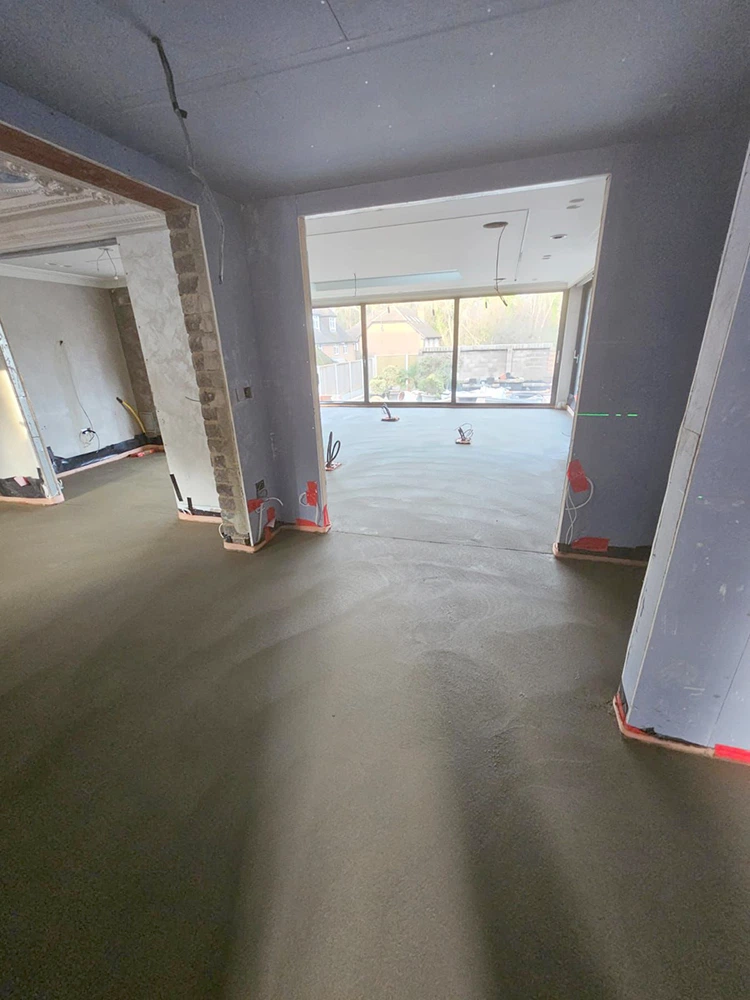
K & B Screeding’s own team, led by director Donatas Bardisevicius. Founded 2019, company 12298780.
See what customers say in our Google reviews and on our testimonials page.
Floor Levelling from Slough to Canterbury
On the map, Canterbury sits east-south-east of Slough, about 76.5 miles from our base in a straight line (postcodes including CT1, CT2 and CT3), next to Whitstable (5.9 miles), Herne Bay (6.7 miles), Faversham (8.5 miles) and Ashford (12.8 miles).
More on floor levelling, part of our screeding services. Not sure whether you need a thin compound or a full flowing screed? See self levelling screed explained.