
Where liquid screed earns its place in Stanford-le-Hope
The mix turns up ready to go, is pushed along a hose into the house and settles flat with only light work from the crew. Because it flows rather than being compacted by hand, one visit covers a large floor, and surface regularity to SR1 or SR2 is readily achievable. To meet SR2, no gap wider than 5mm may show beneath a 2m straightedge.
The rooms that gain most from it here are the ones being opened up. A post-war semi with a new rear extension and the old kitchen wall removed ends up with one long floor spanning two ages of building. One pour covers it all, and since the material shrinks little, most of the joints a hand-laid floor of that size would need can be left out.
Stanford-le-Hope's more recent houses also come into it. Since 2000, 11% of the local housing has gone up, and builds from that period are often drawn with insulation under a flowing screed in the plans. Flats account for 13% of homes, and in an upper-floor flat a pump saves carrying tonnes of material up the stairs.
Getting the thickness right counts for as much as choosing the mix. Where it floats on insulation in a Stanford-le-Hope semi or terrace, the pour starts at around 35mm, and pipes running through it need a minimum 25mm above. Two binders are on offer for it: calcium sulphate and cement. Where the plans for your build give a CA grade, our Stanford-le-Hope anhydrite page sets out what it involves.
Getting the pump to a Stanford-le-Hope room
The pump and mixer lorry have to park within a hose run of the door, so access is the first question on any liquid screed job. Where a semi has its own drive, the pump can usually stand on it, clear of the road, with the hose taken along the side wall. Terraced houses with no way round the back are different: the hose comes through the front of the house and down the hall, and we cover both first. A room on an upper floor needs a longer run and a clear route up the stairs.
Whether the house is in Stanford-le-Hope itself or in Corringham, tell us about yellow lines, bus stops or a shared alley when you ask for a price. An address on a busy road may need an early start. Our pump only ever comes with our own team, as we do not rent out the machine by itself.
On the day, edges are taped, the insulation or pipes checked and depth pins set before the screed goes in. The room then stays closed to traffic for the first day or so. From then on, allow about one day for each millimetre of depth up to 40mm, as our page on drying times explains. For how the two main types compare on cost and speed, read liquid versus sand and cement.
Liquid Screed prices in Stanford-le-Hope
Liquid screed: £24 to £31 per m² supplied and laid (MyJobQuote, August 2026), so £960 to £1,240 for 40 m². MyJobQuote does not say whether these figures include VAT. See our floor screeding cost guide or screed calculator.
Who lays your liquid screed in Stanford-le-Hope
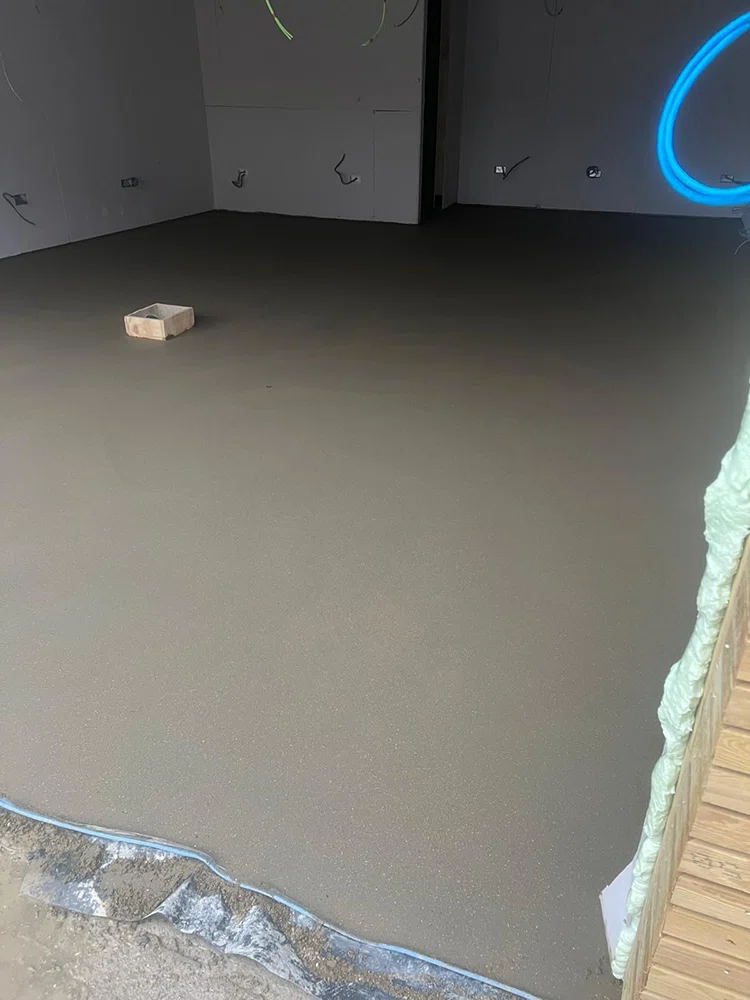
K & B Screeding’s own team, led by director Donatas Bardisevicius. Founded 2019, company 12298780.
See what customers say in our Google reviews and on our testimonials page.
Liquid Screed from Slough to Stanford-le-Hope
Stanford-le-Hope is about 47.2 miles east of our Slough base as the crow flies, with postcodes including SS17. The nearest towns to it are Basildon (3.1 miles), Tilbury (5.7 miles), Grays (6.2 miles) and Gravesend (6.7 miles).
More on liquid screed, part of our screeding services.
