
Grinding garage and extension slabs in Bury St Edmunds
A floor grinder carries rotating heads set with diamond segments. As they spin, they shave the surface off a little at a time, which lets us remove exactly what is in the way and stop.
Garage conversions show why that matters. Houses of that period on the Moreton Hall estate, along with other semis and terraces built between the war and the end of the century, are typical candidates, and the old garage slab usually carries years of oil, tyre marks, floor paint and patch repairs. None of that will hold an adhesive or a primer. Grinding takes the surface back to clean concrete, and the insulation and screed that usually follow are set out in our guide to garage floor screeds.
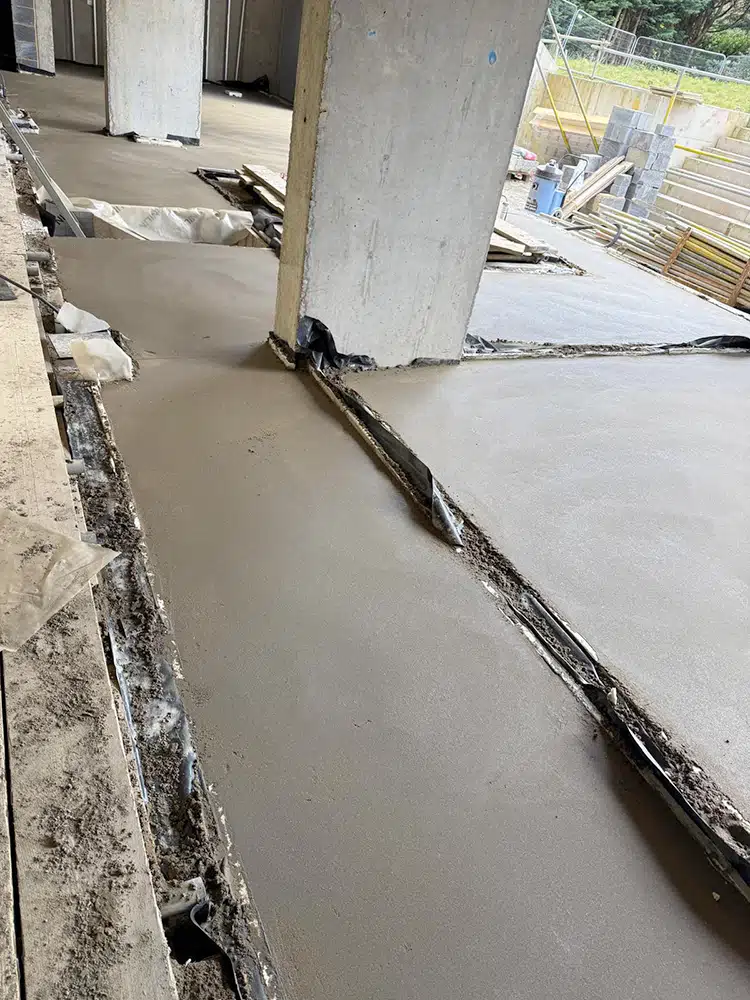
Rear extensions bring a different problem. Where a new slab meets the old house floor, there is often a lip, a ridge of mortar or a slightly proud edge along the line of the removed wall. Grinding that step down by a few millimetres lets a thin compound carry on across both without a hump.
Newer floors are not exempt. Homes built since 2015 account for 11% of the town's stock, and a recent slab or screed can still have trowel ridges or a weak skin on top that flooring adhesive will not grip. Taking that skin off is quicker than waiting for a failure.
Once the surface is clean, the floor is ready for a coat of levelling compound or a thin latex layer, depending on the finish.
Dust, depth and limits on Bury St Edmunds floors
Silica is present in concrete, screed and tile alike. Cutting them throws up a fine dust that can be breathed deep into the lungs, so the grinder never runs without an extraction unit connected. Doors into lived-in rooms are sealed, and in an occupied house we agree which rooms stay closed while the work goes on.
Depth needs restraint. Take too much off a screed and it can end up below the depth it needs to stay strong, so we remove the least that does the job.
Grinding also has a clear limit. It cuts down local high spots, but a room that falls or sags from one side to the other is beyond it. Where old chalk workings have let a floor subside, the cause is investigated before any work on the surface. For a floor that is simply out of level, the usual sequence is to grind the highs and then level or screed.
The British Sugar factory and the Greene King brewery are reminders that the town has food and brewing sites, where floors are designed around heavy loads and hard cleaning, and any new coating on such a floor needs a clean, keyed base under it. Large areas or thick coatings may suit shot blasting and other preparation better.
Our part is the preparation only. No machines or diamond tooling are sold or hired out, and resin or polished concrete floors are left to other firms.
How we price floor grinding in Bury St Edmunds
A fixed written price within 24 hours, once we know the area and what has to come off. See our floor screeding cost guide.
Who grinds your concrete floor in Bury St Edmunds
K & B Screeding’s own team, led by director Donatas Bardisevicius. Founded 2019, company 12298780.
See what customers say in our Google reviews and on our testimonials page.
Concrete Floor Grinding from Slough to Bury St Edmunds
On the map, Bury St Edmunds sits north-east of Slough, about 76.3 miles from our base in a straight line (postcodes including IP33), next to Newmarket (13.1 miles), Sudbury (14.3 miles), Haverhill (16.3 miles) and Soham (17 miles).
More on floor grinding, part of our screeding services.
