
Why liquid screed suits Haverhill's extensions and newer homes
An extension floor on a Haverhill estate house usually follows the same pattern: a concrete slab, insulation, a membrane and then screed, all squeezed into the depth between the slab and the finished floor of the house next door. Every millimetre of screed saved can go into insulation instead.
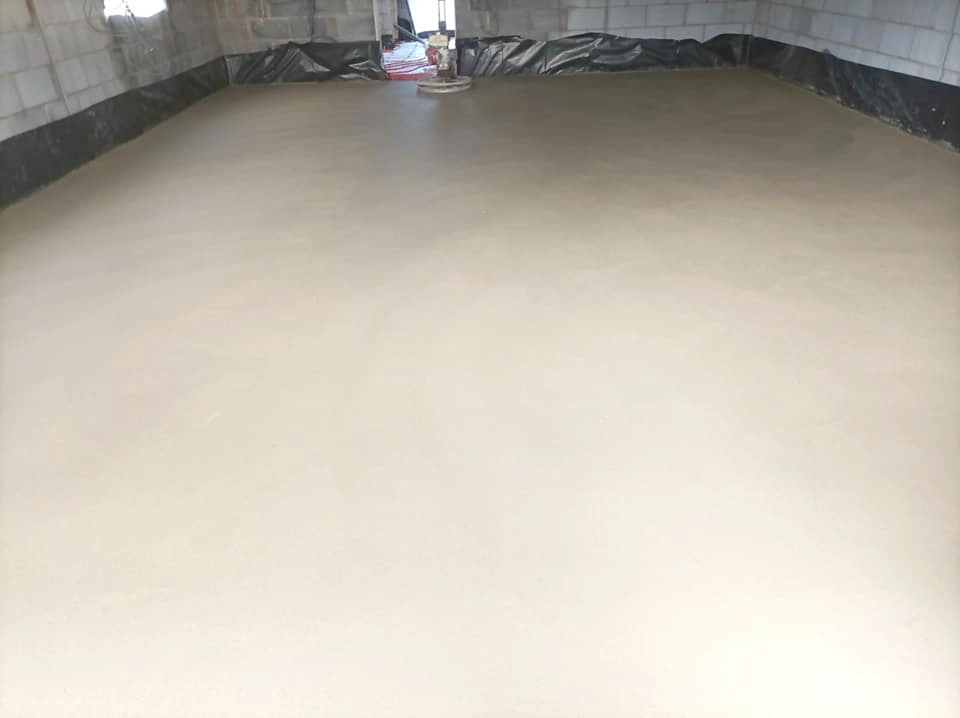
That squeeze is what makes a pumped floor worth considering. Laid floating, a domestic liquid floor can be about 35mm thick, while a traditional sand and cement one needs 65mm. It runs into the corners and round any pipes without leaving gaps, and since it levels itself, reaching SR1 or SR2 is not difficult. That gives a good base for large tiles or LVT across a knocked-through kitchen.
Newer houses often have it built in. Of Haverhill's homes, 25% were built in 2000 or later, and 11% in 2015 or after. Where a newer house already has a flowing screed over insulation or heating, extending with the same material keeps the floors consistent.
Speed is the other benefit. A pump crew can cover a large floor in a day, and shrinkage is low, so there are far fewer joints than with sand and cement.
Our liquid floors are either calcium sulphate or cement bound. Pumping and levelling work identically for each, and the cement bound kind is kept for rooms where water may reach the floor. For a straight comparison with hand-laid screed, read liquid or sand and cement: which to choose.
Pump access and drying in a Haverhill house
On pour day the lorry and pump sit outside the house and a hose is run in to the extension. Some Haverhill houses have a driveway right outside the room; others have only the road. Where the pump has to sit on the road, or the hose must go through a side gate or across a neighbour's frontage, mention it when you ask for a price so the route is planned. Details of hose runs and set-up are on our pumped screed page.
By then the room has to be shut off from the weather and plastered, with edge strip fixed along every wall and the membrane joints taped. Keep the room closed for the first day or two after, then open it up to ventilate.
Drying takes longer than setting. Depth sets the drying clock: each of the first 40 millimetres takes about a day, and anything below that slows further. Only a moisture reading shows when the finish can go down, and the guide to screed drying times walks through the test.
Liquid Screed prices in Haverhill
Liquid screed: £24 to £31 per m² supplied and laid (MyJobQuote, August 2026), so £960 to £1,240 for 40 m². MyJobQuote does not say whether these figures include VAT. See our floor screeding cost guide or screed calculator.
Who lays your liquid screed in Haverhill
K & B Screeding’s own team, led by director Donatas Bardisevicius. Founded 2019, company 12298780.
See what customers say in our Google reviews and on our testimonials page.
Liquid Screed from Slough to Haverhill
On the map, Haverhill sits north-east of Slough, about 60 miles from our base in a straight line (postcodes including CB9), next to Saffron Walden (9.3 miles), Newmarket (11.2 miles), Halstead (12.7 miles) and Sudbury (12.9 miles).
More on liquid screed, part of our screeding services.