
Refitting post-war rooms at Chelsea Gardens and Tithe Farm
Latex screed is the name the flooring trade gives a two part compound. A cement based powder is mixed with a latex liquid rather than plain water, and the latex gives the cured layer a little flexibility and a firm grip on the surface below. It is spread a few millimetres thick, so it smooths a base without adding real height at the doorway.
Chelsea Gardens, Parkside and Tithe Farm went up in the 1950s and 1960s as London overspill estates. On Parkside and Tithe Farm, re-screeding or levelling tired ground floors before new flooring is typical work. In a kitchen or bathroom of that age, lifting the old lino or cushioned vinyl rarely leaves one clean surface. There may be quarry tiles in one corner, a concrete patch where a wall came out and a strip of old adhesive by the back door. Latex can bridge that mix, provided each part is sound and properly primed.
The finishes that gain most are the thin, flexible ones: sheet vinyl, LVT, lino, rubber, safety flooring in a downstairs cloakroom and even carpet, which wears more evenly on a smooth base. Each of them shows the outline of whatever sits underneath.
Where a bedroom or landing has timber boards, those boards are first covered with screwed flooring grade plywood. Latex goes over the plywood, never straight onto bare boards, because boards move with the seasons and would crack a thin coat. For the step between an old kitchen and a new extension, our floor levelling page explains the wider options.
Where latex falls short in Houghton Regis
Latex is a finishing layer, not a cure. Before quoting for any Houghton Regis room, we check whether the base is firm, whether it is dry and how far out of level it is.
Damp comes first. A latex coat will not stop moisture rising through an old slab, and a ground floor that has lost its damp protection needs a membrane and new screed, which is a bigger job than a few millimetres of compound. A hygrometer reading tells us where the floor stands.
Movement is next. Boards that bounce underfoot have to be screwed down, repaired or overboarded before anything goes over them; latex spread onto a springy floor simply cracks along the joints. Loose or hollow tiles are lifted rather than buried.
Level is the third check. If a floor drops away across the whole room, a thin compound cannot correct it, and it needs a local screed repair or a new screed first. Ridges and old trowel marks on concrete can be taken off by grinding the slab before the latex goes on.
Priming ties it together. Tiles, plywood, concrete and old adhesive each take a matched primer, and a calcium sulphate screed always has its laitance removed and is primed. For the same work just over the boundary, see latex screed in Dunstable.
How we price latex screed in Houghton Regis
A fixed written price within 24 hours, once we know the area and the base. See our floor screeding cost guide.
Who lays your latex screed in Houghton Regis
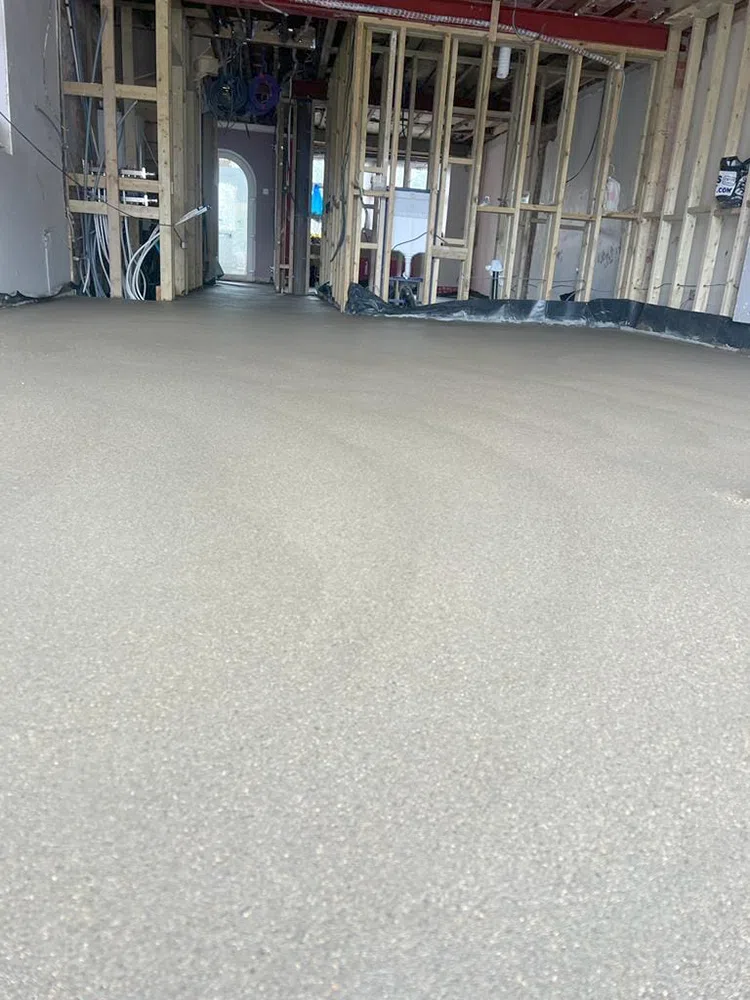
K & B Screeding’s own team, led by director Donatas Bardisevicius. Founded 2019, company 12298780.
See what customers say in our Google reviews and on our testimonials page.
Latex Screed from Slough to Houghton Regis
On the map, Houghton Regis sits north of Slough, about 26.4 miles from our base in a straight line (postcodes including LU5), next to Dunstable (1.3 miles), Luton (4.7 miles), Leighton Buzzard (6.1 miles) and Flitwick (6.8 miles).
More on latex screed, part of our screeding services.
