
Old tiles and patched concrete under Southend-on-Sea refits
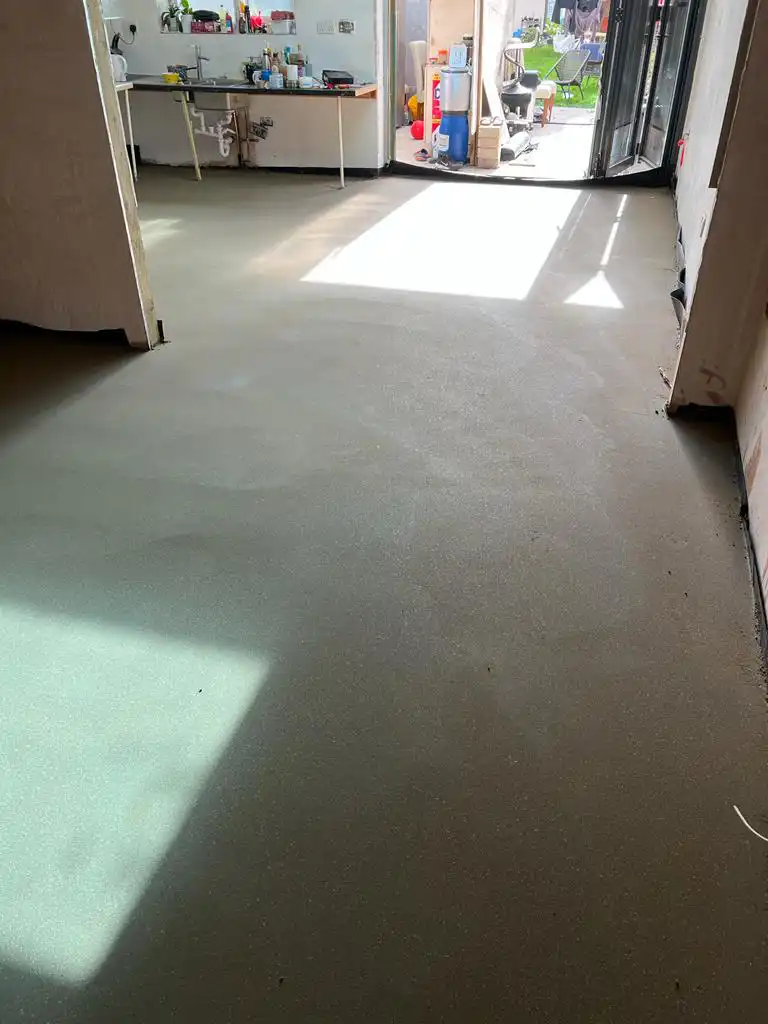
A latex screed starts as two separate parts. The first is a powder with a cement base; the second is a latex liquid that replaces the mixing water an ordinary compound would use. Combined, they set into a thin, smooth skin. Fitters lay it at a few millimetres, so it smooths a floor without lifting thresholds.
The bases it suits are the ones older houses leave behind. In the kitchen of a semi from between the wars or just after, lifting the old covering might reveal quarry or ceramic tiles. If every tile is still firmly bonded, there is no need to hack them up; they are cleaned, primed and skimmed so their grout lines never show through vinyl.
Older concrete is the other common base. A ground floor patched over the years can be solid and dry yet rough, with old repairs at different heights, and latex gives it a single smooth face. A thin, hard film of old adhesive can stay too, provided it is sound and properly primed.
Upstairs, or wherever there are timber boards, flooring grade plywood is screwed over them first, and the latex goes onto the plywood, never onto bare boards.
The finishes that need this most are the thin, flexible ones: sheet vinyl, LVT, lino, rubber and safety flooring in a utility room or a shop kitchen. Where you are not sure whether a floor needs a skim or something more substantial, our Southend-on-Sea levelling page explains the step up to deeper compound.
Damp, bounce and big falls in Southend-on-Sea floors
Some floors are not ready for latex, and laying it anyway only delays the failure. Three faults decide it.
The first is damp. Pre-1919 houses make up a large part of the city, and their solid ground floors may have no damp proof membrane at all. Latex does not hold back ground moisture, and a sheet finish laid over it traps that moisture against the adhesive. In those rooms the floor is usually rebuilt with a membrane, as our sand and cement rebuild page describes, before any skim.
The second is movement. Timber that flexes underfoot cracks a thin compound along the board lines. The boards are fixed down, joists checked, and plywood laid before latex is considered.
The third is level. A floor that drops several centimetres towards a bay window or between two rooms is beyond a few millimetres of latex. Deeper compound or a new screed comes first.
Priming applies to every base. Where a newer flat or extension has a calcium sulphate screed, it always has the laitance taken off and a compatible primer applied. Where a damaged patch of screed needs cutting out before the skim, screed repairs covers it. About 3 miles away, there is also a page for latex screed in Rochford.
How we price latex screed in Southend-on-Sea
A fixed written price within 24 hours, once we know the area and the base. See our floor screeding cost guide.
Who lays your latex screed in Southend-on-Sea
K & B Screeding’s own team, led by director Donatas Bardisevicius. Founded 2019, company 12298780.
See what customers say in our Google reviews and on our testimonials page.
Latex Screed from Slough to Southend-on-Sea
Southend-on-Sea is about 58.5 miles east of our Slough base as the crow flies, with postcodes including SS1, SS3, SS0 and SS9. The nearest towns to it are Rochford (2.9 miles), Rayleigh (5.6 miles), South Woodham Ferrers (8.2 miles) and Wickford (9.6 miles).
More on latex screed, part of our screeding services.