
Which screed suits Lower Sunbury and Sunbury Common
Census 2021 counted 21,476 people in the Sunbury-on-Thames built-up area, and 40% of its homes were built between 1945 and 1972. Ground floors of that age are usually solid slabs laid with little or no insulation.
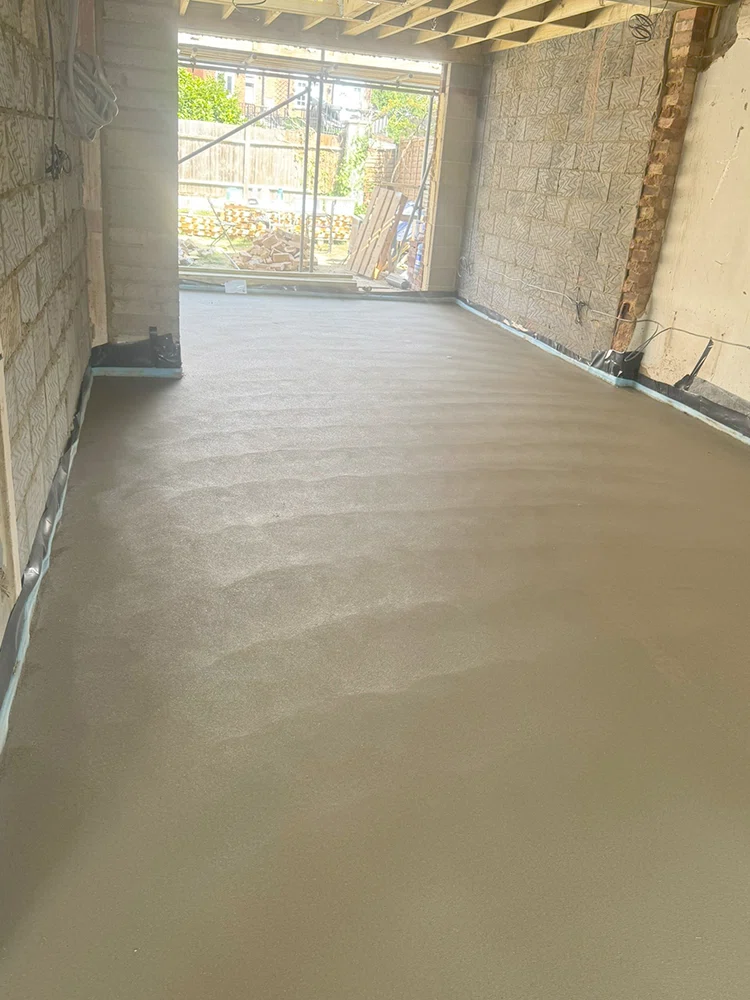
In Lower Sunbury the typical project is a rear kitchen extension or a wraparound. The new floor is insulated, usually heated, and has to finish level with a slab poured in the 1950s or 60s. A wide, open room like that suits pumped liquid screed for Sunbury extensions, and the heated version is explained on our Sunbury underfloor heating screed page.
Sunbury Common brings a different list. Its terraces and flats, including high-rise residential conversions, more often need screed repairs, sound insulation between flats and a smooth surface for new coverings. Ripping out a whole screed is rarely needed in those homes, and a levelling coat under the new covering tends to solve it.
Hand-laid traditional sand and cement screed still has a place everywhere in town. It handles small rooms, bathrooms laid to falls and garages, and it can go where a floor may get wet.
Conversions sit at the far end of the scale. The former Chubb Fire and Security building, now homes, is the kind of building where every floor needs a complete new build-up of insulation, membrane and screed, which is where a specified calcium sulphate flow screed often comes into the conversation.
Homes in Sunbury-on-Thames at a glance
The most common home in Sunbury-on-Thames is a semi-detached house (28%), ahead of flats at 26%. The largest share of its housing, 40%, was built between 1945 and 1972, and 23% between the wars.
| Homes in Sunbury-on-Thames | Share |
|---|---|
| Detached houses | 21% |
| Semi-detached houses | 28% |
| Terraced houses | 24% |
| Flats | 26% |
| Built before 1919 | 6% |
| Built 1919 to 1944 | 23% |
| Built 1945 to 1972 | 40% |
| Built 1973 to 1999 | 14% |
| Built since 2000 | 15% |
House types from Census 2021 (table TS044); building age from the Valuation Office Agency council tax stock of properties, 31 March 2026 (table CTSOP 4.1). Figures cover the Sunbury-on-Thames built-up area (E63005130).
Screeding services in Sunbury-on-Thames
- Liquid ScreedOpen-plan extensions on Lower Sunbury semis suit pumped liquid screed.
- Sand and Cement ScreedOlder Sunbury-on-Thames floors, from riverside listed buildings to 1930s houses, often need sand and cement screed relaid by hand.
- Underfloor Heating ScreedLower Sunbury kitchen extensions join a 1950s slab to new underfloor heating.
- Anhydrite & Flow ScreedConversions like the former Chubb building in Sunbury-on-Thames need a full floor build-up. We pour specified anhydrite grades, laitance advice in writing.
- Floor LevellingBP's research centre and the offices around Sunbury Cross need flat floors for new finishes.
- Latex ScreedKitchen and bathroom refits in Lower Sunbury's 1930s to 1960s houses often uncover old tiles or boards.
- Concrete Floor GrindingOffice refits by Sunbury Cross and lips at Lower Sunbury extension joins: Sunbury-on-Thames concrete grinding with dust extraction.
We also offer fibre reinforced screed, quick drying screed, high strength screed, bonded screed, floor preparation, screed repairs, concrete floor repair, screed pumping, insulation & membranes, commercial screeding and residential screeding in Sunbury-on-Thames.
Access, parking and timing a Sunbury-on-Thames pour
We cover the whole town, including Felthamhill, Kempton Park, Lower Halliford, Upper Halliford and Sunbury Common. Postcodes here include TW16 and TW17.
Parking near Sunbury Cross or on a Common terrace decides a lot. A liquid screed needs a mixer and pump parked close enough for the hose to reach the room, so a terrace with permit or kerbside parking needs a plan agreed with neighbours the day before. A flat in one of the taller blocks needs the hose run up a stair or through a window, and the managing agent usually wants notice. A sand and cement screed arrives as materials and is mixed on site, which suits tight frontages but takes longer to lay.
Where your build has got to matters just as much. Rain must be kept out, so glazing and outside doors go in ahead of pour day, by which point your builder has put down insulation plus membrane and your heating engineer has tested any pipework under pressure. Plastering can come before or after, but wet trades nearby slow the drying. Roughly speaking, 30mm of screed wants about 30 days, the pattern holds to 40mm and then slows, so count forward from the pour before you book a fitter.
If an existing floor has failed rather than needing a new one, start with our screed repairs service.
Screeding prices for Sunbury-on-Thames floors
Sand and cement £18 to £25 per m², liquid £24 to £31 per m², supplied and laid (MyJobQuote, August 2026). MyJobQuote does not say whether these figures include VAT. See our floor screeding cost guide.
Who lays your floor screed in Sunbury-on-Thames
K & B Screeding’s own team, led by director Donatas Bardisevicius. Founded 2019, company 12298780.
See what customers say in our Google reviews and on our testimonials page.
Reaching Sunbury-on-Thames
As the crow flies, our yard in Slough is about 12.5 miles from Sunbury-on-Thames, which lies to the south-east. Postcodes here include TW16 and TW17, and Ashford (2.1 miles), Walton-on-Thames (2.3 miles), Weybridge (3.7 miles) and Chertsey (4.1 miles) are close by. Neighbourhoods we cover in Sunbury-on-Thames include Felthamhill, Kempton Park, Lower Halliford and Sunbury Common.
See our screeding services for every screed type we lay.
