
Large floors and new homes at Buckler's Park
The bigger the floor, the stronger the case for pumping. A self-levelling screed spreads across a whole extension, kitchen and family room in one continuous pour, and because it shrinks very little it needs far fewer joints than a traditional screed. Large format tiles and long boards of engineered wood want SR1 or SR2, and a pumped floor gets there without much trouble.
Crowthorne's large detached houses on generous plots are made for this. Substantial extensions and open-plan ground floors are a common project here, and the usual build-up is a liquid screed laid over insulation.
New building is the other half of the story. At Buckler's Park, on the former Transport Research Laboratory land off Nine Mile Ride, homes and apartments are being built in phases, with screed going in over new insulated slabs. Flats account for 17% of the village's homes, and on an upper floor a hose saves carrying heavy material up the stairs.
Depth is modest. About 35mm is the starting depth over insulation in a house, against roughly 65mm for sand and cement, and that saving is what lets a new extension floor finish flush with the old house. Whether it is made with calcium sulphate or cement depends on the room it goes in. The differences are laid out in our guide comparing pumped and hand-laid screed.
Driveways, hoses and drying across Crowthorne
Only the hose comes indoors; the pump stays out front. On most Crowthorne plots a driveway gives the mixer a place to stand, and the hose runs through a side door, patio doors or the extension opening to the floor. Long drives and gated entrances are fine, but tell us the distance so enough hose comes on the day.
Before we pour, the floor has to be sealed and contained. Edge strip goes around every wall to allow for movement, the membrane over the insulation is taped at every joint so screed cannot leak beneath it, and doorways are dammed. We check all of it before starting.
Drying takes planning. It will take your weight once 24 to 48 hours have passed. Flooring is another matter: nothing goes down until the screed meets the moisture figure the flooring maker allows. As a guide it dries at a millimetre a day up to 40mm, then slower, and our screed drying guide has tips for speeding it up. If the new floor is heated, the heating can help once the screed allows it; underfloor heating screed in Crowthorne covers when. We also pour liquid screed in Sandhurst, next door.
Liquid Screed prices in Crowthorne
Liquid screed: £24 to £31 per m² supplied and laid (MyJobQuote, August 2026), so £960 to £1,240 for 40 m². MyJobQuote does not say whether these figures include VAT. See our floor screeding cost guide or screed calculator.
Who lays your liquid screed in Crowthorne
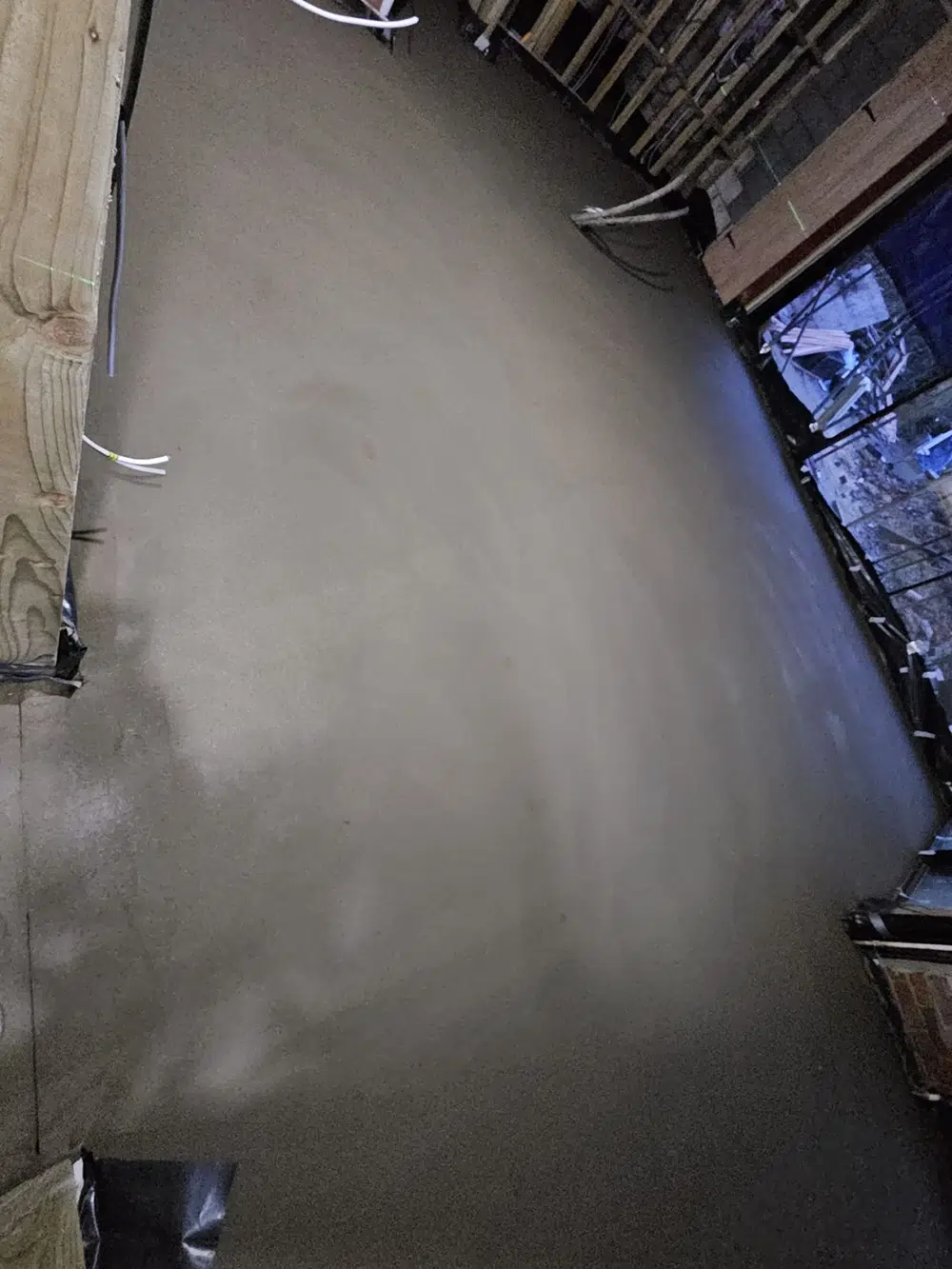
K & B Screeding’s own team, led by director Donatas Bardisevicius. Founded 2019, company 12298780.
See what customers say in our Google reviews and on our testimonials page.
Liquid Screed from Slough to Crowthorne
On the map, Crowthorne sits south-south-west of Slough, about 13 miles from our base in a straight line (postcodes including RG45), next to Sandhurst (1.6 miles), Yateley (2.3 miles), Camberley (3 miles) and Wokingham (3.3 miles).
More on liquid screed, part of our screeding services.
