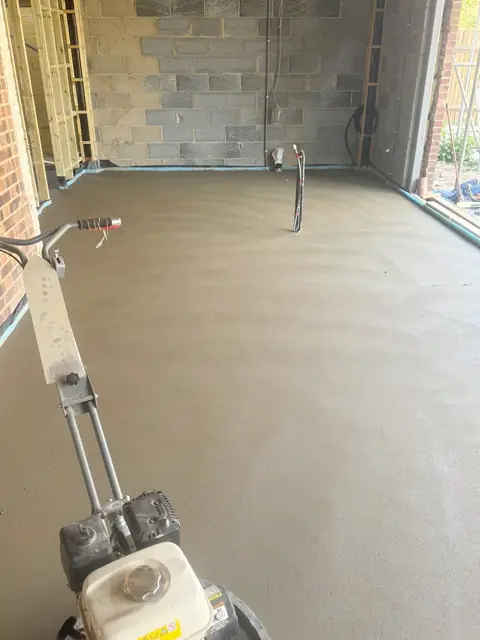
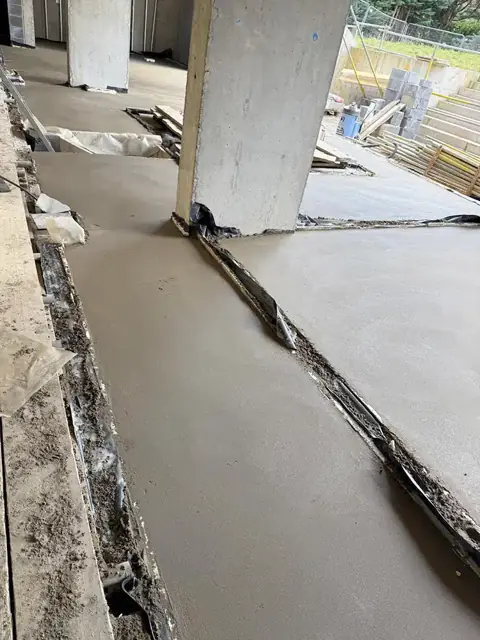
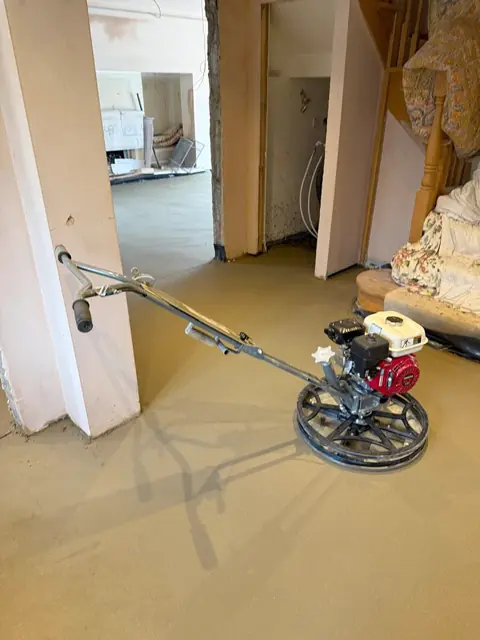
"Ready mix screed" usually means a semi-dry sand and cement screed batched in a plant, retarded so it does not set too early, and delivered to site ready to lay. The alternative is to mix sand, cement and water on site, by hand, in a forced action mixer or in a mixer pump. Both produce the same kind of floor. What changes is who controls the mix, how long you have to lay it and how it gets to the room.
Short answer: order ready mix screed when the floor is big enough to use a full delivery in one day, the material can be tipped close to the work, and you want a factory controlled cement content. Mix on site when the job is small, access is tight, the floor is being pumped with a mixer pump, or the laying will be spread over several days.
When ready mix screed is the better choice
Ready mix earns its place on medium to large floors where a team can lay steadily from morning to afternoon. It removes a common cause of weak screed, a mix batched by the shovel with too little cement, and it saves bagging and carrying cement on site.
It is a weaker choice when:
- the floor is a single room or a few square metres, so most of a delivery would be left over;
- there is nowhere near the house to tip loose screed, or the street has no space to stand it;
- the work has to stop and start, for example a floor laid in phases around other trades;
- the screed needs to reach a rear extension, an upper floor or a basement, where a mixer pump that mixes and pumps on site is often simpler.
Ready mix, site mixed and bagged screed compared
| Ready mix (retarded) screed | Site mixed screed | Pre-blended bagged screed | |
|---|---|---|---|
| Where it is batched | In a plant, to a set recipe | On site, by the gang | In a factory, water added on site |
| Consistency | High, set by the producer | Depends on the people batching | High, if water is added carefully |
| Working time | Retarded, for example about 12 hours for Cemex Readyscreed | Mixed in batches as it is laid | Mixed in small batches as it is laid |
| Standard | Should meet BS EN 13813 (BS 8204-1, clause 5.6) | Normally made to BS 8204 recommendations | Factory produced, so BS EN 13813 (check the bag) |
| Delivery | Loose tipped or bulk bags | Sand and bagged cement delivered separately | Pallets of bags |
| Suits | Medium to large floors, one day pours | Small, awkward or phased floors, mixer pump work | Patches and very small areas |
| Main risk | Unused material once the working day is over | Wrong cement content, uneven batches | Cost per m² and handling on larger floors |
Swipe the table sideways to see every column.
The working time and standards in the table come from the Cemex Readyscreed product page and the Mineral Products Association (MPA) screeds data sheet, listed under Sources. Bagged screed is covered here only as a comparison point; our guide to bags of screed covers the products and how many you need.
What ready mix screed is and how long it stays workable
Ready mix screed is a factory produced mortar of sharp sand and cement, with an admixture that slows the set. MPA Mortar describes factory screeds as produced under tightly controlled conditions and "delivered to site ready to use and sufficiently retarded".
How long it stays usable depends on the product. Cemex says its Readyscreed range is "retarded for a specific time, generally 12 hours and thus remain usable for one working day". Marshalls describes its semi-dry Standard Screed as "set-retarded to give ample time for placing and finishing" and offers it loose tipped or in bulk bags, for barrow or pump use. Always check the delivery ticket and data sheet for the product you are sent, because the working time is a property of that mix.
Some ready mix screeds come with extra features built in. Marshalls includes polypropylene fibres in its Standard Screed, and Cemex offers Original, Early Strength and Reinforced (fibre) versions of Readyscreed. That overlaps with what we do on site in our fibre reinforced screed: the fibres help control plastic shrinkage cracking, whichever way the screed is made.
What ready mix does not change is the laying. It still has to be spread, fully compacted, ruled off and floated by hand, the same as a site mix. Our sand and cement screed page sets out each of those steps.
Site mixed screed: control and its risks
Site mixing means sand and cement are delivered separately and combined with water as the work goes on. It is the traditional method and the one we use as standard for sand and cement floors, because each batch can be made as the laying keeps pace.
Where site mixing works well
- Small and awkward areas. Landings, steps, single rooms and patches need only what is mixed.
- Phased work. Batches can stop at the end of a bay and start again the next day without waste.
- Pumped floors. A screed mixer pump mixes a batch at the kerb and blows it along a hose to the room, which is how semi-dry screed gets to a rear extension, upstairs or into a basement. Our screed pumping page explains how we plan the hose route.
- Adjusted mixes. Fibres or rapid drying additives can be added on site to suit the job.
The risks
The weak point is batching. BS 8204-1, as summarised by the MPA, recommends nominal proportions of 1 part cement to 4 parts sand by weight, with limits of 1:3 and 1:4.5. A gang that measures by the shovel, runs short of cement or adds extra water to make the mix easier to spread can end up with a screed that is too weak at the surface. That is the failure that shows up later as a dusty or crumbling surface.
Good site mixing is about measuring, not guessing: whole bags of cement per batch, a consistent amount of sand by weight or by gauge box, and just enough water for the mix to ball in the hand without being wet. Our guide to DIY vs professional screeding covers mix ratios and sand choice in more detail.
Consistency, strength and BS 8204
The reason consistency matters is in the standards.
- BS EN 13813 is a performance standard. It classes screeds by compressive and flexural strength, for example C20 or C25. The MPA notes that factory produced screeds are required to conform to it.
- BS 8204-1 is the UK code of practice for cementitious levelling screeds. According to the MPA, clause 5.6 says ready mixed screeds should meet the performance requirements of BS EN 13813, while screeds made on site are normally produced to the BS 8204 recommendations.
- The MPA adds that a screed batched at the BS 8204-1 proportions, or with a strength class of C20 or C25, would meet the expected criteria for in situ crushing resistance, which is the floor's resistance to being crushed by loads and traffic in use.
In plain terms, ready mix comes with a declared strength from a controlled plant. A site mix can meet the same standard, but only if the batching is right every time. The MPA screeds page lists the factory benefits as accurate cement content, consistent strength and reduced wastage.
Neither method changes depth, curing or drying. The MPA data sheet gives the same thickness guidance whichever way the screed is made, and it says a ready to use screed should be covered with plastic sheeting or similar to retain moisture for at least five days.
| Construction | Minimum (MPA, BS 8204) | Notes |
|---|---|---|
| Bonded to a prepared slab | 25mm | 40mm normally specified to take up base deviations |
| Unbonded, on a membrane | 50mm | 70mm specified to allow for deviations |
| Floating, over insulation | 75mm | 65mm normally satisfactory in housing |
Swipe the table sideways to see every column.
A sand and cement screed then dries at roughly one day per millimetre for the first 40mm, and slower after that, whether it came from a plant or a mixer.
Access, delivery size and waste
On a real house job the decision often comes down to logistics rather than the mix itself.
Where it lands. Loose ready mix is tipped. It needs a clean, hard spot close to the work and a way to barrow or pump it in. On a terraced street with no drive, that can mean a parking suspension or not using loose ready mix at all.
How much you need. Work out the volume first: area times depth. A 30m² extension floor at 65mm is 30 × 0.065 = 1.95m³ before any allowance for an uneven base. Our screed calculator does the sum and adds a margin. Ask the supplier how they sell it and what the minimum load is, because a small floor can leave you paying for screed you cannot use.
The clock. Once retarded screed is on site, the working day has started. Everything must be ready before it arrives: levels set, insulation and membrane down, edge strip fitted, and enough people to compact and finish the whole delivery.
Waste. Ready mix reduces waste from cement bags and miscut batches. It can create waste of its own if the order is too large or the day goes wrong. Site mixing produces only what you need, but cement bags must be stored dry and used before they go off.
Health. HSE warns that wet cement trapped against skin can cause serious burns, and its precautions include considering pre-mixed concrete or mortar to cut contact with cement powder. Waterproof gloves, boots and washing facilities are needed with either method.
What it costs
Most people are pricing a finished floor, not the screed alone. MyJobQuote (August 2026) puts supply and lay sand and cement screed at about £18 to £25 per m² and labour only at about £10 to £12 per m². trade2base (June 2026) adds about £1 to £3 per m² for fibres and puts screed pump hire at about £300 to £600 per day. The supply method changes how a contractor prices the material and the labour, but a fixed laid price already includes it. Our floor screeding cost guide breaks these figures down, and our post on screed cost per m³ looks at pricing by volume.
A quick checklist before you order
- Measure the area and confirm the depth for your construction from the table above.
- Decide how the screed will reach the room: barrow, mixer pump or line pump.
- Check where a delivery can be tipped or a mixer pump can stand.
- Confirm the base, insulation, membrane and edge strip are ready.
- Match the quantity to what one team can lay and finish in a day.
- Book the curing: polythene and protection for at least five days.
Get a fixed price for your floor
If you are weighing up ready mix against site mixing, send us the details and we will tell you which supply method suits the floor and give a fixed price for the screed laid and finished. It helps to include:
- the floor area in m², or a sketch with dimensions;
- the depth or build-up, and whether there is insulation or underfloor heating;
- what will go on top, such as tiles, timber, vinyl or carpet;
- the access: distance from the road, steps, upper floors and parking;
- the site postcode.
Use our contact form or call 07466 650936. We call back the same day, send a written quote within 24 hours and agree the price before work starts. We cover towns within about 80 miles of Slough; see our areas we cover.
Sources
- Data sheet 22: Screeds, Issue 3, Mineral Products Association (MPA Mortar), published October 2023, accessed October 2026
- Screeds, MPA Mortar, accessed October 2026
- BS 8204-1:2003+A1:2009 Concrete bases and cementitious levelling screeds to receive floorings, BSI Knowledge, accessed October 2026
- Screed products and Readyscreed, Cemex UK, accessed October 2026
- Readyscreed sand cement screed, Cemex UK, accessed October 2026
- Semi dry screed: Standard Screed, Marshalls, accessed October 2026
- Cement: health risks and precautions, Health and Safety Executive, accessed October 2026
- Floor screeding cost guide, MyJobQuote, updated 12 August 2026, accessed October 2026
- Floor screed costs UK 2026, trade2base, published 8 June 2026, accessed October 2026