
Refitting units on The Causeway and Wycke Hill Business Park
Commercial refits test a floor harder than most homes. When a unit changes hands on The Causeway in Heybridge, the district's main employment area, or a unit is refitted at Wycke Hill Business Park or West Station Yard, the new finish tends to show every dip in the old base. Carpet tiles forgive a little. Vinyl sheet, LVT and big tiles show every hollow.
Flatness has its own scale under BS 8204, checked by resting a 2m straightedge across the slab and measuring the biggest gap beneath it. The tightest class, SR1, allows 3mm; SR2 lets that grow to 5mm, and SR3 to 10mm. Many thin sheet products ask for SR1, which is how a unit floor on The Causeway that lived happily under carpet can suddenly fall short when vinyl goes on the drawings.
Compound normally goes on between roughly 2mm and 10mm thick, though some products allow more. Before any compound goes down on a Causeway unit, we clean the base and prime it with a product that suits what is there: concrete, sand and cement, calcium sulphate, or adhesive left behind by earlier flooring. Get that pairing wrong and the compound tends to come away later.
Industrial units often need more than a skim. Worn slabs with high spots, old coatings or broken areas are dealt with first by concrete floor grinding or repair, so the compound has something sound to bond to. Quick setting products help a West Station Yard refit stay on its dates, and a big unit can be done in sections so trading carries on in the rest.
Joining old and new floors in Maldon homes
In a Maldon house, trouble usually shows up at the doorway into a new extension, as a lip or a slope. On one side is a fresh, true floor; on the other, an older one that has sunk a little or was never flat to begin with. A self levelling compound brings the two together and takes out small dips, so a single run of flooring can cross the doorway without a ridge.
The houses of the 1970s to 1990s across Maldon and Heybridge raise the same question during kitchen and ground floor refits, where an old screed sits at the wrong level for the new floor.
Compound has limits. It only smooths the surface and adds no strength, so pouring it deep to save a floor that really wants new screed tends to end in cracks and lifting. Where the base sounds hollow, breaks up, or is further out than compound can take, the floor wants a new screed, often relaid in sand and cement. Where only a few millimetres are needed over boards or old tiles, latex screed is another option. Once we have seen your floor, you get a straight answer on which of these it needs.
How we price floor levelling in Maldon
A fixed written price within 24 hours, once we know the area and the base. See our floor screeding cost guide.
Who levels your floor in Maldon
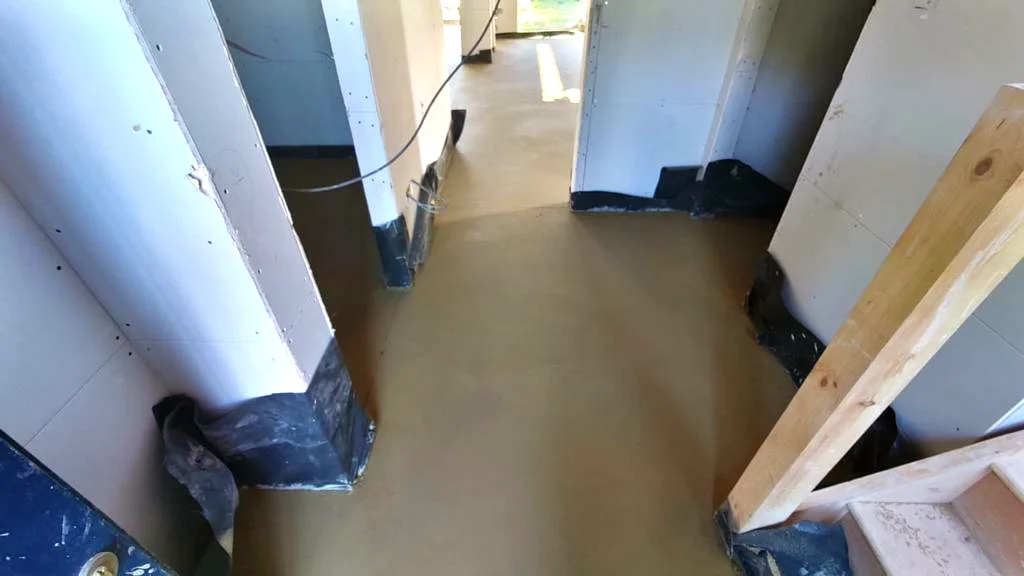
K & B Screeding’s own team, led by director Donatas Bardisevicius. Founded 2019, company 12298780.
See what customers say in our Google reviews and on our testimonials page.
Floor Levelling from Slough to Maldon
Maldon is about 58.6 miles east-north-east of our Slough base as the crow flies, with postcodes including CM9. The nearest towns to it are Witham (5 miles), South Woodham Ferrers (6.5 miles), Chelmsford (8.8 miles) and Rochford (10.4 miles).
More on floor levelling, part of our screeding services. Not sure whether you need a thin compound or a full flowing screed? See self levelling screed explained.
