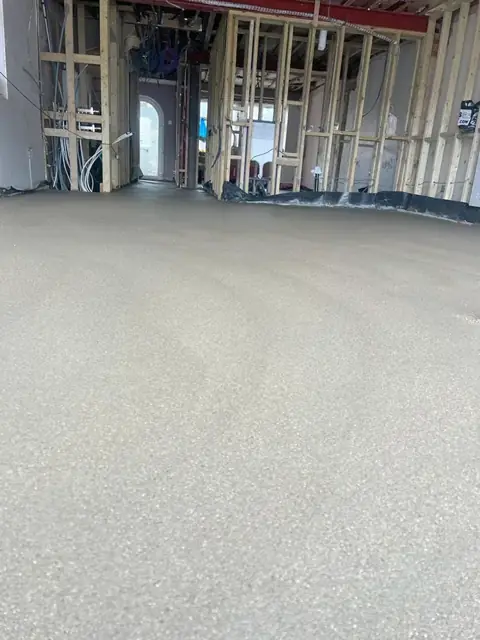
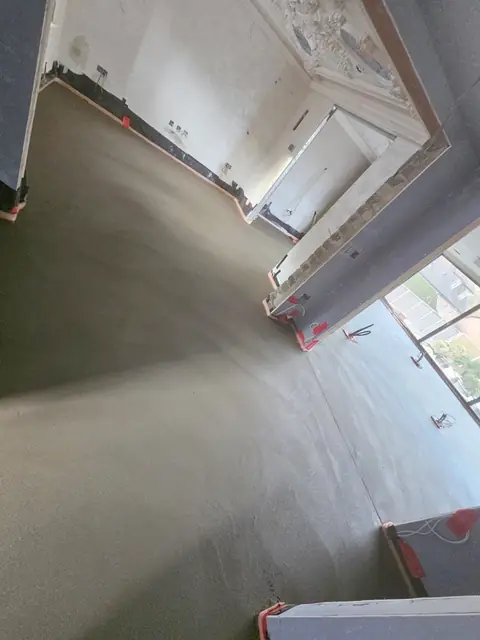
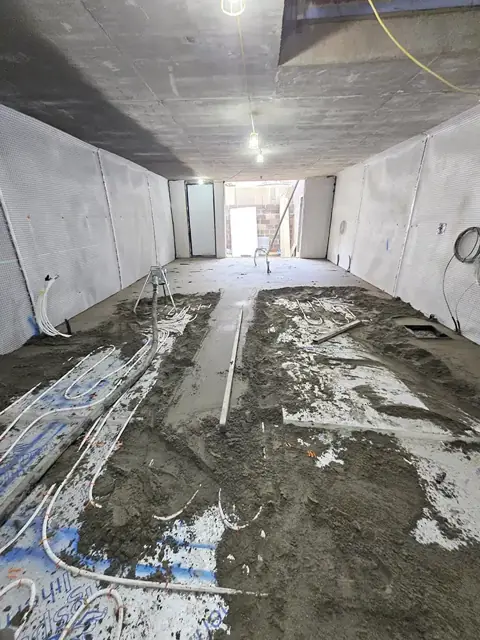
People search for "self levelling screed" when they want an uneven floor made flat for LVT, vinyl, tiles or wood. In most cases they mean a levelling compound: a thin, flowing layer poured over a floor that is already sound. This post prices that job. If you need a full depth floor over insulation or heating pipes, that is a new screed, and our floor screeding cost guide further down prices it instead.
Short answer: levelling an existing floor with self levelling compound typically costs £10 to £20 per m² in 2026 (trade2base, June 2026). Labour alone is about £10 to £25 per m², and grinding off high spots adds about £8 to £15 per m². A thin 3mm skim sits at the low end. A floor that needs 10mm or more, or a lot of preparation, costs more.
These are published market figures, not our price list. We price every floor on its own and agree a fixed price before we start.
Self levelling screed cost per m2 in 2026
We could only find one set of dated 2026 UK figures for levelling compound itself, and they come from trade2base. MyJobQuote's August 2026 screeding guide does not price levelling compound, so we have not borrowed a figure from it.
| Item | Typical 2026 price | Source |
|---|---|---|
| Self levelling compound over concrete, laid | £10 to £20 per m² | trade2base, June 2026 |
| Floor levelling compound, labour only | £10 to £25 per m² | trade2base, June 2026 |
| Grinding down high spots on concrete | £8 to £15 per m² | trade2base, June 2026 |
| Floor grinding or scarifying | £5 to £15 per m² | trade2base, June 2026 |
| Plywood overlay on a timber subfloor | £15 to £25 per m² | trade2base, June 2026 |
| Old flooring removal and disposal | £5 to £10 per m² | trade2base and MyJobQuote, 2026 |
| Bonded sand and cement screed, 25 to 40mm | £12 to £18 per m² | trade2base, June 2026 |
Swipe the table sideways to see every column.
trade2base lists self levelling compound as "floor prep for coverings" and describes it as "a finish prep layer, usually 3 to 10mm". Treat £10 to £20 as the price of that thin layer. It is not a price for filling a dip 30mm deep.
Prices in London and the South East tend to sit higher: trade2base puts experienced floor layers there at £250 to £400 a day, against £200 to £350 nationally. Very small areas also cost more per m², because travel, mixing and set up cost the same whatever the size.
Price by depth: 3mm, 6 to 10mm and deep fill
Depth is the biggest reason two quotes for the same room differ. Compound is sold by the bag, and every extra millimetre uses more of it. F. Ball's own coverage figures make the point clearly.
| Depth band | Typical product type | Coverage per bag (F. Ball) | Bags for a 15m² kitchen |
|---|---|---|---|
| About 3mm, smoothing | Smoothing compound such as Stopgap 300 | 5.0m² at 3mm | 3 |
| 5mm | Smoothing compound | 3.0m² at 5mm | 5 |
| 10mm, levelling | Heavy duty smoothing compound | 1.5m² at 10mm | 10 |
| 20mm, deep fill | Deep section base compound such as Stopgap 600 | 0.7m² at 20mm | 22, plus a smoothing cap |
| 50mm, deep fill | Deep section base compound | 0.3m² at 50mm | 50, plus a smoothing cap |
Swipe the table sideways to see every column.
The bag counts are simple arithmetic from F. Ball's published coverage, rounded up. Real floors are rarely one depth all over, so the true figure falls somewhere between bands.
What this means for price:
- 3mm smoothing. A room can usually be done in a single visit, and material is a small part of the cost. Expect the lower end of the £10 to £20 per m² range.
- 6 to 10mm levelling. Two to over three times the material of a 3mm skim, and more care with primer and spiking. This is still inside trade2base's 3 to 10mm band, so expect the upper end of the range, or above it once preparation is added.
- 20 to 40mm deep fill. A general smoothing compound is the wrong product. F. Ball rates Stopgap 300 for 2mm to 20mm, and its Stopgap 600 deep section compound for 5mm to 75mm, and says Stopgap 600 is capped with one of its smoothing compounds before new floor coverings go down. So a deep fill is two products and two pours, with many more bags.
Our floor levelling page explains why most compounds are laid from about 2mm up to around 10mm, with some products deeper.
Preparation that is often in the price
Preparation is the part of the price people do not expect, and it can cost as much as the compound. Compound only bonds to a clean, sound, primed base.
- Removing the old floor. Vinyl, carpet, tiles and adhesive have to come up first. trade2base and MyJobQuote both put removal at about £5 to £10 per m².
- Grinding. High spots, ridges, old adhesive and weak laitance are ground off. trade2base puts grinding high spots at £8 to £15 per m². Grinding produces silica dust, so it needs dust extraction. See floor preparation.
- Crack and hole repairs. Cracks, hollow patches and broken edges are cut out and filled before levelling, otherwise they reflect through the new surface.
- Priming. Every base needs the primer the manufacturer specifies. On its Stopgap 300 page, F. Ball points to Stopgap P141, an acrylic primer for non absorbent surfaces. Calcium sulphate (anhydrite) screeds also need their laitance removed before priming.
- Timber floors. Bare floorboards are not a base for compound. They are usually overboarded with plywood first, which trade2base prices at £15 to £25 per m².
A quote that looks cheap often leaves some of these out. Ask what is included.
Typical room totals: hallway, kitchen, open plan ground floor
Here is what trade2base's £10 to £20 per m² works out to on common rooms, for a thin layer over a sound concrete or screed base. The last column adds grinding at £8 to £15 per m² to show how much preparation can move the total.
| Room | Area | Levelling at £10 to £20 per m² | With grinding added |
|---|---|---|---|
| Hallway | 6m² | £60 to £120 | £108 to £210 |
| Kitchen | 15m² | £150 to £300 | £270 to £525 |
| Kitchen diner | 25m² | £250 to £500 | £450 to £875 |
| Open plan ground floor | 40m² | £400 to £800 | £720 to £1,400 |
Swipe the table sideways to see every column.
Two cautions. A 6m² hallway will rarely be priced at £60: the visit, mixing and primer cost much the same as a bigger room. trade2base notes that most experienced floor layers apply a minimum charge of at least half a day's labour to any room under about 8m². And these totals assume a thin layer. A kitchen that needs 10mm or deep fill in one corner will cost more than the table shows.
You can work out your own floor area and depth with our screed calculator.
When levelling stops being cheaper than a new screed
Self levelling compound is the cheaper answer when the floor is sound and only a few millimetres out. It stops being cheaper, and stops being sensible, when:
- The dips are 20mm to 40mm deep over a large area. trade2base prices a bonded sand and cement screed at £12 to £18 per m² for 25mm to 40mm. A deep fill of compound uses many times the material of a thin skim and still needs a smoothing cap, so at this depth a bonded screed is often the more economical option. A bonded screed is laid onto the prepared slab and becomes part of it.
- The existing screed is weak, hollow or cracked through. Compound on a failing base cracks and debonds with it. The base needs repair or replacing first.
- There are big steps between rooms. Feathering compound across a large step uses a lot of material and rarely ends well.
- There is no floor, or the old one is coming out. Then you need a full depth screed. Our floor screeding cost guide prices that.
Our guide to latex, self levelling compound or a new screed explains how to tell which your floor needs.
How to check your own floor
Lay a 2 metre straightedge on the floor in several directions and measure the biggest gap underneath. BS 8204 sets SR1 at 3mm, SR2 at 5mm and SR3 at 10mm. Thin finishes such as LVT and sheet vinyl usually want SR1. If your gaps are under about 10mm, compound is likely to be right. If they are well over that, ask about a screed.
Get a fixed price for your floor
The quickest way to a firm number is to send us:
- Photos of the floor, including any cracks, old adhesive or steps.
- The area in m², or the room sizes.
- The biggest gap you found under a straightedge, if you checked.
- What flooring is going down, such as LVT, tiles or engineered wood.
- Your postcode, so we can check access and travel.
We will tell you which levelling depth the floor needs, what preparation is included, and give you a fixed price in writing within 24 hours. The price we agree is the price you pay. Send your details on our contact page or call 07466 650936.
We cover towns within about 80 miles of our base in Slough, mainly London and the Home Counties. Our self levelling screed page explains how we lay it.
Sources
- Flooring Installation Costs UK, Carpet, Laminate, LVT and Hardwood Pricing Guide (2026), trade2base, published 8 June 2026, accessed 1 October 2026
- Flooring Installation Pricing Guide UK (2026), trade2base, published 8 June 2026, accessed 1 October 2026
- Concrete Flooring Costs UK, Screed, Polished Concrete and Overlay Pricing Guide (2026), trade2base, published 8 June 2026, accessed 1 October 2026
- Floor screed costs UK, trade2base, June 2026, accessed 1 October 2026
- Floor screeding cost guide, MyJobQuote, last updated 12 August 2026, accessed 1 October 2026
- Stopgap 300 heavy duty smoothing compound, F. Ball and Co., accessed 1 October 2026
- Stopgap 600 deep section base compound, F. Ball and Co., accessed 1 October 2026