Most damp concrete floor problems come down to one of two things: a new slab or screed that has not dried yet, or an old floor that was built with no damp proof membrane at all. A liquid DPM can solve both, within limits. It cannot stop water that is pushing up under pressure, and it is not a substitute for the membrane a new floor needs under its insulation and screed.
Short answer: a liquid DPM is a waterproof coating applied to the top of a prepared concrete floor or sand and cement screed so that moisture in or below it cannot reach the floor covering. Epoxy types such as F. Ball's Stopgap F77 are stated for bases up to 98% relative humidity (RH), compared with the 75% RH most floor coverings need. The membrane is then normally primed and covered with a smoothing compound before the flooring goes down.
Figures below come from Approved Document C and the data sheets under Sources. If your product's data sheet differs, follow it.
Liquid DPM vs sheet DPM: which does what
A damp proof membrane can sit in three places in a ground floor: under the slab, on the slab under a screed, or on the finished surface. The table compares the main types, and they do different jobs.
| Membrane | Where it goes | What it is for | Key limits |
|---|---|---|---|
| Polythene sheet DPM | Below or above the concrete slab, under insulation and screed | Stopping ground moisture in a new floor | At least 300 micron (1200 gauge), joints sealed, linked to the wall DPC (Approved Document C) |
| Liquid DPM on the slab, under a screed | On top of the concrete, then covered | The same job as the sheet, in liquid form | Three coats of cold applied bitumen solution or similar, protected by a screed or floor finish (Approved Document C) |
| Two part epoxy surface DPM (for example Stopgap F77) | On the finished slab or screed, under the smoothing compound | Residual construction moisture and rising damp | Up to 98% RH; up to 90% RH over underfloor heating; not where there is hydrostatic pressure |
| One part surface DPM (for example Stopgap F78) | On the finished slab or screed, under the smoothing compound | Residual construction moisture only | Up to 95% RH in two coats; base must already have a structural DPM; not over calcium sulphate screeds or underfloor heating |
Swipe the table sideways to see every column.
The practical difference is this. A sheet membrane is part of building the floor and is laid before the slab or screed. A surface DPM is a fix applied after the floor exists, when it is too wet for the flooring you want or when there was never a membrane under it.
Sheet DPM under the screed vs liquid DPM on top
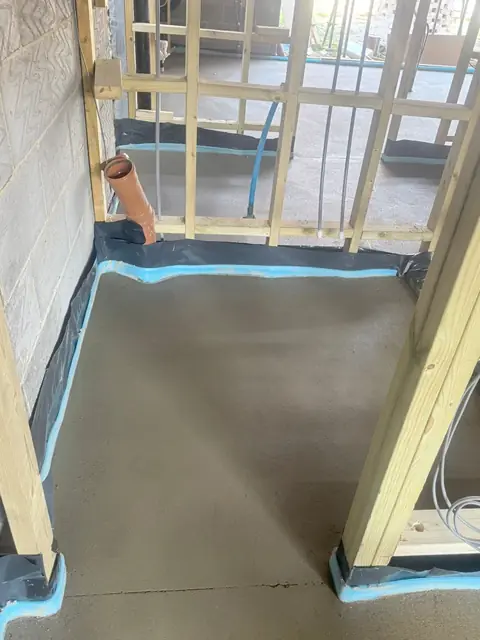
Approved Document C, paragraph 4.7, says a ground supported concrete floor should have a damp proof membrane above or below the concrete, continuous with the damp proof courses in the walls. Paragraph 4.8 describes the usual sheet: polyethylene at least 300 micron thick with sealed joints, laid on a bed that will not damage it.
Paragraph 4.9 allows the membrane to go on top of the slab instead, as either the same polythene sheet or "three coats of cold applied bitumen solution or similar moisture and water vapour resisting material". Either way it must be protected by a screed or floor finish. So a liquid DPM painted onto a slab and then screeded over is a recognised way to build a floor, not a shortcut.
Two things follow when you screed over a membrane of any kind:
- The screed cannot bond to the slab. It becomes an unbonded screed and needs the greater depth that goes with that. Our screed thickness guide sets out the minimums.
- The screed can only dry upwards. That slows drying, which matters if flooring is booked in.
In a new extension or new build with insulation, the membrane normally goes under the insulation as a lapped and taped polythene sheet. That build up, with insulation, slip membrane and edge strip, is covered on our insulation and membranes page.
Using a surface DPM to floor a screed that is not dry
This is the most common reason people search for a liquid DPM. The screed is down, the flooring fitter is booked, and the hygrometer reading is well above 75% RH.
F. Ball's subfloor preparation guide says that where there is not enough time to let a base dry naturally, bases reading more than 75% RH (65% RH for solid wood floors) should be treated with a waterproof surface membrane. Its data sheets give these limits:
- Stopgap F77 (two part epoxy): one coat, up to 98% RH at 1.8 m² per kg, or up to 85% RH at 2.5 m² per kg. Over underfloor heating screeds, up to 90% RH.
- Stopgap F78 (one part, ready to use): two coats, up to 95% RH at 3.3 m² per kg. Only for bases that already contain a structural DPM. Not for calcium sulphate (anhydrite) screeds or floors with underfloor heating.
The F77 data sheet and F. Ball's guide say new concrete or sand and cement screed should be at least 7 days old before it is prepared and coated. Both data sheets require hygrometer readings to Appendix A of BS 8203 and BS 5325 to be taken and recorded first.
A surface DPM can save weeks on a cement screed, but drying costs nothing if the programme allows it. Our guide on how long screed takes to dry shows typical drying rates, and screeding before flooring lists the RH limits flooring makers set.
Calcium sulphate screeds are different. F78 must not be used on them, and their laitance has to come off before anything is applied. If an anhydrite floor is reading wet, check the screed and membrane manufacturers' guidance before choosing a product, and consider whether heating it to dry is the better route.
Damp old floors with no membrane
Older houses often have solid floors laid with no DPM. F. Ball's guide notes that older floors with vinyl tiles were often laid without a structural damp proof membrane. Put an impermeable floor such as LVT or vinyl over one, and moisture that used to evaporate through the old finish gets trapped under it.
Here the choice of product matters:
- A one part membrane such as F78 is not suitable, because its data sheet requires an existing structural DPM.
- An epoxy membrane such as F77 is stated to impede rising damp as well as construction moisture, up to 98% RH, and should be taken over the whole floor and up to the damp proof course in the wall.
- Nothing in this class is for water under pressure. The F77 data sheet says not to use it where the subfloor is subject to hydrostatic pressure. A floor that is visibly wet, floods, or is below ground level, such as a basement, needs a waterproofing design. The code of practice for that is BS 8102:2022, Protection of below ground structures against water ingress, and it is a specialist job.
Before covering an old floor, also look at what the floor is made of. F. Ball warns that magnesite (magnesium oxychloride) composition floors are damaged by rising damp under an impervious layer and must be removed unless they are protected. Old vinyl tiles and their adhesive may contain asbestos and need professional advice before removal.
If the old floor is badly broken, hollow or far out of level, a membrane and a thin compound will not fix it. That is the point to break it out and build a new floor with a proper sheet DPM, insulation and screed.
Applying a liquid DPM: preparation, coats and levelling over it
The steps below follow the Stopgap F77 and F78 data sheets. Other brands are similar, but always work to the data sheet of the product in the bucket.
- Test first. Take hygrometer readings across the floor and record them. The reading decides whether you need a membrane and which coverage rate applies.
- Prepare the surface mechanically. The base must be clean and absorbent, with laitance and surface hardeners removed to a slightly textured surface. Power floated concrete must be mechanically prepared. F. Ball's guide notes that most power floated slabs carry a curing agent, and says F77 should be used on them only once the surface has been shot blasted. See floor preparation.
- Check strength and repair. Surface strength should be greater than 1.5 N/mm² (BS 8204-6). Repair rough or damaged areas with a compatible compound first.
- Check conditions. The floor must be above 10°C. For F77 the base must be at least 3°C above the dew point, or condensation can cause the layers above to fail.
- Apply over the whole floor. Take it up to the DPC in the wall. F77 is mixed in full packs, spread with the supplied trowel and rolled. F78 goes on in two coats at right angles, the second once the first is touch dry, after about 15 to 30 minutes at 20°C.
- Look for a continuous film. It must be pinhole free. If an absorbent base soaks it in and leaves a dull finish, another coat is needed.
- Do not bridge movement joints. Stop the membrane at the joint and seal the joint afterwards with a flexible, impervious jointing compound.
- Prime, then level. F77 cures in about 3 hours at 20°C, then takes neat Stopgap P141 primer before a smoothing compound. The exceptions are Stopgap 1200, which the data sheet allows directly within 24 hours of curing, and Stopgap 1500, which F. Ball's guide adds to that list. Compounds can go directly onto F78 within 12 hours of it curing; after that it needs another coat.
- Lay the smoothing compound. F. Ball's guide calls for a minimum 3mm of smoothing compound in several of these situations, and recommends one before resilient floor coverings even where an adhesive could go straight on the membrane. Stopgap 300, for example, is laid from 2mm to 20mm and lists F. Ball surface membranes among its suitable bases. Our floor levelling page covers this stage.
Over underfloor heating, F77's data sheet expects the screed to have been laid and the system commissioned in line with BS 8204-1, and adds a heating rule: once the system has been commissioned, turn it off for 48 hours before, during and for 48 hours after the membrane, compound and flooring go down, then bring it back up gradually.
Liquid DPM or sheet membrane: a quick decision guide
| Your situation | Usual answer |
|---|---|
| New ground floor or extension, nothing laid yet | Polythene sheet DPM, linked to the wall DPC, under insulation and screed |
| Slab already cast, screed not yet laid, no membrane in place | Sheet DPM or a liquid DPM to Approved Document C on the slab, then an unbonded screed |
| New cement screed reading over 75% RH, flooring booked | Surface DPM rated for the reading, primer and smoothing compound |
| New anhydrite screed reading wet | Remove laitance, check the manufacturer's route, consider force drying |
| Old solid floor, no DPM, damp but not wet | Rising damp rated epoxy surface DPM, taken up to the DPC, then compound |
| Basement or water coming through under pressure | Not a surface DPM job; a below ground waterproofing design to BS 8102 |
Swipe the table sideways to see every column.
Get a fixed price for your floor
If your floor is reading damp or you are not sure it has a membrane, send us a few details and we will recommend a sheet membrane or a surface DPM and price it with any preparation and levelling needed:
- photos of the floor and the edges where it meets the walls;
- the floor's age and what it is made of, if you know;
- any hygrometer readings and where they were taken;
- the area in m² and what flooring is going on top;
- the postcode.
Contact us or call 07466 650936. We call back the same day, send a written quote within 24 hours, and agree a fixed price before any work starts. We cover London and the Home Counties within about 80 miles of Slough; see the areas we cover.
Sources
- Approved Document C: Site preparation and resistance to contaminants and moisture (online version with 2010 and 2013 amendments), HM Government, accessed 1 October 2026
- BS 8204-1:2003+A1:2009 Screeds, bases and in situ floorings: concrete bases and cementitious levelling screeds, BSI, accessed 1 October 2026
- BS 8102:2022 Protection of below ground structures against water ingress, BSI, accessed 1 October 2026
- Stopgap F77 technical data sheet, F. Ball and Co., July 2023
- Stopgap F78 technical data sheet, F. Ball and Co., September 2025
- Subfloor preparation guide, F. Ball and Co., accessed 1 October 2026
- Stopgap 300 heavy duty smoothing compound, F. Ball and Co., accessed 1 October 2026