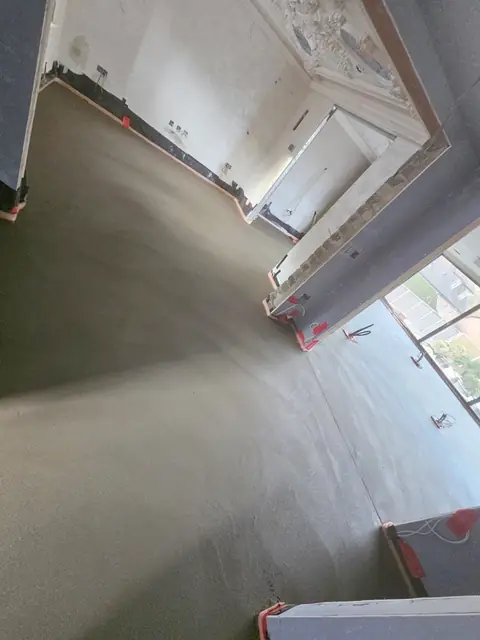
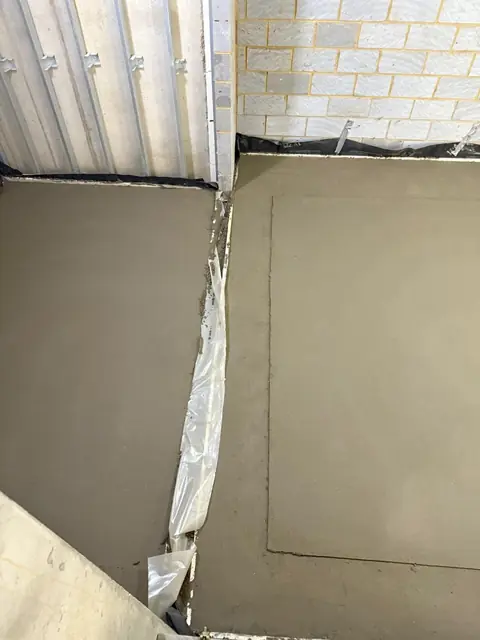
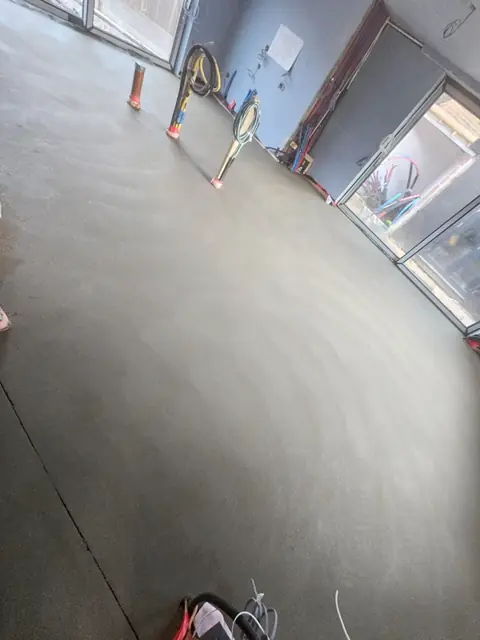
Most refurbishments hit the same problem. The old floor is sound but out of level by 20mm, 30mm or more, a new kitchen extension sits higher than the old house, or a tiled floor has been ripped up and left a rough, patchy slab. A smoothing compound cannot fill that much, and digging out for a full new screed means weeks of drying. Renovation screeds and deep fill compounds fill the gap between the two.
Short answer: a renovation screed is a rapid setting, bagged screed or deep section base compound laid bonded to a sound existing floor. Depending on the product, it fills from about 10mm to 75mm in one application, with some deep base compounds starting at 5mm, and takes floor coverings within hours or a couple of days, not weeks. Each product has its own limits, so the data sheet decides.
Thickness limits: smoothing compound, deep base, renovation screed, full screed
Short answer: general smoothing compounds stop at about 20mm, latex with aggregate at about 30mm, deep base compounds go to about 75mm, rapid bonded screeds sit at about 15mm to 40mm, and anything floating or over insulation needs a full screed of 65mm or more in a home.
The figures below are taken from UK manufacturers' product pages and the Mineral Products Association's data sheet on screeds, which summarises BS 8204. They are stated limits for those named products, not general rules, and site temperature changes every time shown.
| Material | Example product | Stated thickness | Walk on | Floor coverings |
|---|---|---|---|---|
| General purpose smoothing compound | F. Ball Stopgap Green Bag | 3mm to 20mm | From 90 minutes | From 12 to 24 hours at 3mm, depending on the liquid used |
| Heavy duty smoothing compound | F. Ball Stopgap 300 | 2mm to 20mm | 90 minutes | From 6 hours on absorbent bases |
| Latex compound | ARDEX ARDITEX NA | Feather edge to 12mm neat, up to 30mm with coarse aggregate | 2 hours | 4 hours (ceramic tiles 3 hours) |
| Deep section base compound | F. Ball Stopgap 600 | 5mm to 75mm in one application | From 90 minutes | From 6 hours, after a smoothing compound on top |
| Rapid screed, bonded | ARDEX A 38 | 15mm to 40mm bonded | 3 hours | Tiles after 4 hours; carpet, wood and vinyl after 48 hours |
| Traditional sand and cement, bonded | Site mixed | 25mm minimum, 40mm normally specified (MPA) | 24 to 48 hours | Roughly a day per mm for the first 40mm |
| Traditional sand and cement, floating | Site mixed | 65mm in homes, 75mm commercial | 24 to 48 hours | Weeks to months |
Swipe the table sideways to see every column.
Two things stand out. First, the "deep" products only work bonded to a sound base. ARDEX gives A 38 an unbonded minimum of 50mm and a floating minimum of 65mm in homes, the same as a traditional screed, so the rapid binder does not let you lay thinner over insulation or a membrane. Second, a deep base compound is a base, not a finish. F. Ball lists Stopgap 600 as needing one of its smoothing compounds, such as Stopgap 300 or 1200, on top before floor coverings go down.
For the thin end of this range, our guide to latex, self levelling compound or a new screed covers the products under about 10mm. For full depths, see the screed thickness guide.
What about Mapei Ultraplan Renovation Screed?
Mapei sells a product in the UK called Ultraplan Renovation Screed 3240, and it is a name many people search for. We could not verify its current UK product page or data sheet for this guide, so we have not quoted its thickness or drying figures here rather than repeat unchecked numbers. If you are using it, download the current technical data sheet from Mapei and check three things before you buy: the minimum and maximum thickness in one pour, the primer it needs on your base, and the time before your particular floor covering can go down.
The same advice applies to every product in this category. Two bags that look alike can have very different limits, and a renovation screed poured outside its stated range is no longer covered by the manufacturer's data.
Bonded to the old floor: why preparation decides success
Short answer: renovation screeds and deep base compounds rely on a full bond to the floor below, so the base has to be sound, clean, mechanically prepared where needed and primed with the product the manufacturer names.
A thin layer cannot carry load on its own. It works because it becomes part of the slab or screed beneath it. The MPA's data sheet on screeds puts it plainly: a bonded screed should be at least 25mm thick, 40mm should normally be specified to allow for deviations in the base, and the hardened concrete must be prepared by mechanical methods to maximise bond. Fully bonded screeds, it says, have the least risk of cracking, curling and hollowness.
In practice, that means:
- Check the base is sound. Tap test for hollow areas. Cracked, loose or crumbling screed is cut out and repaired first, because a new layer bonded to a weak one fails with it.
- Remove what stops the bond. Laitance, paint, old adhesive, oil and dust all sit between the new material and the floor. Our floor preparation service covers grinding and shot blasting to get back to clean, sound material.
- Prime correctly. Each manufacturer names its own primers for absorbent and non absorbent bases. Calcium sulphate (anhydrite) screeds need their laitance removed and a compatible primer before any cement based product goes on.
- Deal with moisture first. No compound or screed cures rising damp. If the base is damp, a surface membrane may be needed, and that can change the build up.
- Lay within the product's range. If part of the floor needs 5mm and part needs 50mm, the product must cover both, or the deep areas are built up first.
Where the existing floor sits on a membrane or insulation, or the old screed is weak throughout, bonding is not possible. That floor needs an unbonded or floating screed at full depth, which is where a renovation product stops being the answer.
Drying: days, not months
Short answer: rapid renovation screeds and deep base compounds take floor coverings in hours to a couple of days, against roughly a day per mm for the first 40mm of a traditional sand and cement screed.
This is the main reason people choose them. A traditional 40mm bonded sand and cement screed can need around 40 days before a moisture sensitive floor goes down, and longer in cold or damp conditions; trade2base gives the same 40+ day figure for traditional sand and cement. By contrast, ARDEX states that A 38 can take tiles after 4 hours and carpet, wood and vinyl after 48 hours, and F. Ball lists floor coverings on Stopgap 600 from 6 hours.
Three cautions apply:
- Most stated times assume 20°C. ARDEX and F. Ball quote their smoothing compound and rapid screed times at 20°C, and a cold, unheated room in winter slows every product.
- The base must be dry too. A fast product over a wet screed traps the moisture beneath it.
- Test before impermeable floors. Vinyl, LVT, rubber and wood should go down only once the floor passes the moisture test the flooring maker asks for, often a hygrometer reading of about 75% relative humidity. Our guide on how long screed takes to dry explains the test.
If you need a full depth screed rather than a renovation layer and time is tight, a quick drying screed uses the same idea at normal thicknesses.
Where renovation screed fits in a refurbishment
Short answer: use a renovation screed or deep base when a sound floor is between about 10mm and 50mm out, and lay a new screed when there is no sound base to bond to or you need insulation in the floor.
| Situation | Usual fix |
|---|---|
| Sound slab or screed, under 10mm out, rough or patched | Smoothing compound, see floor levelling |
| Sound slab, 10mm to 40mm out, or a step to an extension | Rapid bonded screed or deep base compound, capped with smoothing compound if needed |
| Sound slab, 25mm to 40mm needed, and the programme allows drying time | Traditional bonded screed |
| Old screed hollow, cracking or crumbling over large areas | Break out and lay a new screed |
| New insulation, membrane or underfloor heating going in | Floating screed at full depth |
| Suspended timber floor | Overboard with plywood, then a compound made for timber bases |
Swipe the table sideways to see every column.
Common jobs where the middle band works well:
- Kitchen extensions where the new slab ends up higher than the old house and the step needs closing.
- Floors left rough after tile removal, where old adhesive beds have left ridges and hollows.
- Older ground floors with a sag, where the slab is sound but dips towards the middle.
- Commercial fit outs with a fixed opening date and existing slabs that are out of level.
Check the height first. Every millimetre added raises thresholds, door bottoms, skirting lines and the bottom stair riser. On a refurbishment that is often the real limit, not the product.
What it costs
We have not found published UK prices per square metre for renovation screeds or deep base compounds, so we do not quote an average for them. For comparison, trade2base (June 2026) puts a bonded sand and cement screed at about £12 to £18 per m², and MyJobQuote (August 2026) puts a fast drying screed at about £20 to £28 per m², both supplied and laid.
Rapid products cost more than site mixed screed. MyJobQuote's materials only figures put fast drying screed at £14 to £18 per m² against £12 to £15 for traditional screed, and trade2base notes that polymer modified screeds cost more because they dry faster. That extra is often worth it when it saves weeks of waiting for a floor to dry. The other big variable is preparation, such as grinding off old adhesive or removing laitance, which is priced on what is on the floor now. Our floor screeding cost guide covers how screed prices are built up.
Get a fixed price for your floor
Tell us how far out the floor is and how much height you have, and we will say whether a renovation screed or a new screed is the cheaper long term fix.
To price it, send us:
- The area in m², or room sizes.
- How far out it is: the largest gap under a straightedge, or the step height to the next room.
- The height available before doors, thresholds or stairs become a problem.
- What the base is (concrete, sand and cement, anhydrite, old tiles) and what is on it now.
- What goes on top: tiles, LVT, wood or carpet.
- Your postcode.
Use our contact form or call 07466 650936. We call back the same day, send a written quote within 24 hours, and agree a fixed price before work starts.
Sources
- ARDEX UK: ARDEX A 38 rapid drying screed, ARDEX UK, accessed October 2026
- ARDEX UK: ARDITEX NA levelling and smoothing compound, ARDEX UK, accessed October 2026
- ARDEX UK: latex based levelling and smoothing compounds, ARDEX UK, accessed October 2026
- F. Ball: Stopgap 600 deep section base compound, F. Ball and Co., accessed October 2026
- F. Ball: Stopgap 300 heavy duty smoothing compound, F. Ball and Co., accessed October 2026
- F. Ball: Stopgap Green Bag general purpose smoothing compound, F. Ball and Co., accessed October 2026
- Mortar data sheet 22: Screeds, Mineral Products Association, accessed October 2026
- BS 8204-1:2003+A1:2009, concrete bases and cementitious levelling screeds, BSI, accessed October 2026
- Floor screed costs UK, trade2base, June 2026
- Floor screeding cost guide, MyJobQuote, August 2026