Most people searching for a screed mix ratio want one number they can give a merchant or a labourer. There is one, and it is in the British Standard. The less obvious part is that the ratio is rarely what makes a screed fail. Water content, the sand and, above all, compaction decide whether a 1:4 screed is hard and sound or dusty and hollow.
Short answer: a traditional floor screed is 1 part cement to 4 parts sharp sand by weight. BS 8204-1 allows a range of 1:3 (richer) to 1:4.5 (leaner), and fine concrete screeds with aggregate up to 10mm use 1:4 to 1:5.
The standard screed mix ratio
The Mineral Products Association's data sheet on screeds (Issue 3, October 2023) summarises BS 8204-1, the code of practice for cementitious levelling screeds. It says the standard recommends nominal proportions by weight of cement to fine aggregate of 1:4, with a lower limit of 1:3 and an upper limit of 1:4.5.
Two further points from the same data sheet are worth knowing:
- A screed made to those proportions is expected to meet the standard's criteria for in situ crushing resistance, which is the old idea of "soundness".
- A screed with a compressive strength class of C20 or C25 under BS EN 13813 would also meet those criteria. That is how factory made screeds are specified, by performance rather than by recipe.
So for an ordinary floor in a house or extension, 1:4 is the answer. Going richer is a choice made for heavy use, not a default.
By weight or by volume?
The standard expresses the ratio by weight. On site, and on MPA Mortar's own product page, screeds are often described by volume, as in "a 1:4 mix" measured in gauge boxes or buckets. The two are not exactly the same thing, because a bucket of cement and a bucket of sand do not weigh the same. What matters most is that every batch is measured the same way. Gauge boxes or weighed batches keep it consistent in a way a shovel count does not.
Screed mix ratio by floor type
BS 8204-1 does not give a different ratio for each kind of floor. The nominal 1:4 mix covers most of them. What changes is the construction, the depth, whether fibres go in and how the screed is finished. This table brings those together.
| Floor | Typical mix (cement to sand) | Minimum depth | What else matters |
|---|---|---|---|
| Bonded to a concrete slab | 1:4, or 1:3 where more strength is specified | 25mm, with 40mm normally specified | Slab prepared mechanically; laid onto a wet bonding coat |
| Unbonded, on a membrane | 1:4 | 50mm, with 70mm normally specified | Curling and hollowness are more likely at joints and edges |
| Floating over insulation (home) | 1:4 | 65mm in housing | Fibres reduce shrinkage cracking; edge strip at walls |
| Over underfloor heating | 1:4, usually with fibres | 65mm domestic floating, about 45mm over the pipes | Heating brought up gradually, not before 21 days |
| Bathroom or wet room | 1:4 cement based | As for the construction used | Cement screed suits wet areas; calcium sulphate does not |
| Heavy duty or commercial | 1:3 to 1:4, or a fine concrete screed at 1:4 to 1:5 | 75mm floating; bonded preferred for heavy use | Compaction and curing decide the strength achieved on site |
| Rapid drying binder | As the product sheet says, for example 1:5 | As the product sheet says | Specific sand, water and mixer rules apply |
Swipe the table sideways to see every column.
Depths are from the MPA data sheet and our own service pages. Our screed thickness guide explains the minimums in more detail. The bonded construction is the one the MPA describes as having the least risk of cracking, curling and hollowness, and the preferred method where heavy duty use or a rigid flooring is needed. That is why heavy duty floors often come down to construction, not just a richer mix. Our high strength screed page covers those floors.
The last row matters. Proprietary binders are designed around their own ratio. ARDEX's product page for its A 38 rapid drying screed cement gives a typical mix of 1 part A 38 to 5 parts screeding sand, sand to BS EN 13139 (0 to 8mm graded), 10 to 11 litres of water per 25kg bag and a forced action mixer, not a free fall mixer. Mixing it at 1:4 "to be safe" would not follow the manufacturer's instructions.
How much cement and sand you need
Our screed calculator assumes laid sand and cement screed weighs roughly 2,100kg per m³. Using that figure, the quantities for each cubic metre of laid screed work out as follows.
| Mix by weight | Cement per m³ | 25kg bags per m³ | Sharp sand per m³ |
|---|---|---|---|
| 1:3 | about 525kg | about 21 | about 1.6 tonnes |
| 1:4 | about 420kg | about 17 | about 1.7 tonnes |
| 1:4.5 | about 380kg | about 15 | about 1.7 tonnes |
| 1:5 | about 350kg | 14 | about 1.75 tonnes |
Swipe the table sideways to see every column.
As a worked example, a 10m² floor at 65mm is 0.65m³. At 1:4 that is roughly 11 bags of cement and 1.1 tonnes of sand, before any allowance for waste or an uneven base. These are estimates for ordering, not a mix design. For what those quantities cost by the cube or tonne, see screed cost per m3.
Getting the water right: the semi-dry ball test
A traditional screed is a semi-dry mix. It is far stiffer than mortar or concrete, and it should look only just damp. The water is what most often goes wrong, because a wetter mix is easier to spread and feels like progress.
The usual site check, done on every batch, is simple:
- Take a handful of mixed screed straight from the mixer.
- Squeeze it hard in a gloved fist.
- Open your hand. The screed should hold together as a firm ball and keep the marks of your fingers.
- Check your glove. There should be no water running out between your fingers and no slurry left on the palm.
- If the ball crumbles as soon as you open your hand, the mix is too dry to compact and bond. Add a little water and mix again.
- If it slumps or weeps, it is too wet. Add more sand and cement in the same ratio rather than more cement alone, so the proportions stay right.
A mix that is too wet is weaker at the surface, shrinks more as it dries and takes longer to dry. Our guide to sand and cement screed describes the consistency the same way: it holds together when squeezed but is nowhere near runny.
The sand matters as much as the cement
Screed is made with sharp sand. MPA Mortar describes cement based levelling screeds by the ratio of cement to "0/4 sharp sand", meaning sand graded from fine particles up to 4mm. Cemex's screed FAQs say sharp sand is the usual choice for a fine domestic screed, and that a heavy duty or industrial screed may need a larger aggregate of around 6 to 10mm. That larger mix is a fine concrete screed, which the standard proportions at 1:4 to 1:5.
Soft building sand, the kind used for brick mortar, is the wrong material for a floor screed. If you are buying sand yourself, ask the merchant for screeding sand or sharp sand and use the same delivery for the whole floor, so the grading does not change halfway across.
Why compaction matters more than an extra bag of cement
The common reaction to a dusty or crumbly screed is to add more cement next time. It rarely solves the problem. A semi-dry screed is full of air when it comes out of the mixer, and it only reaches the strength its mix is capable of when it is compacted firmly through its full depth. A 1:3 screed with voids in the bottom half can perform worse in use than a 1:4 screed that has been properly tamped.
This is measurable. The MPA data sheet describes the BRE screed tester used to check in situ crushing resistance: a 4kg weight is dropped 1m down a guide onto a steel anvil on the screed, four times, and the depth of the dent is measured. The test measures the screed as laid, so poor compaction shows up whatever the mix was on paper. BS 8204-1 sets acceptable indentation depths by use and floor covering.
On a properly laid screed we look for:
- Compaction in layers on deeper floors, so the bottom of a 65mm or 75mm screed is as dense as the top.
- Small batches, placed and compacted before they start to stiffen.
- A wet bonding coat under bonded screeds, never one that has already dried.
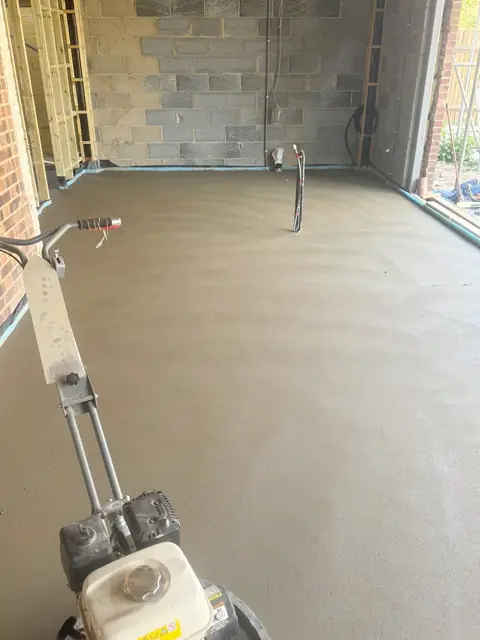
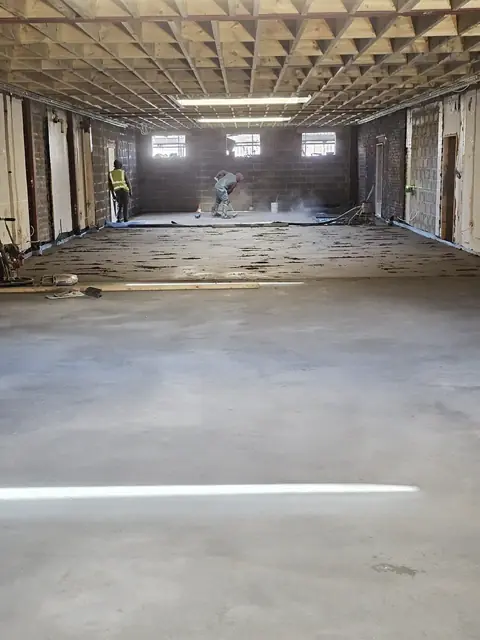
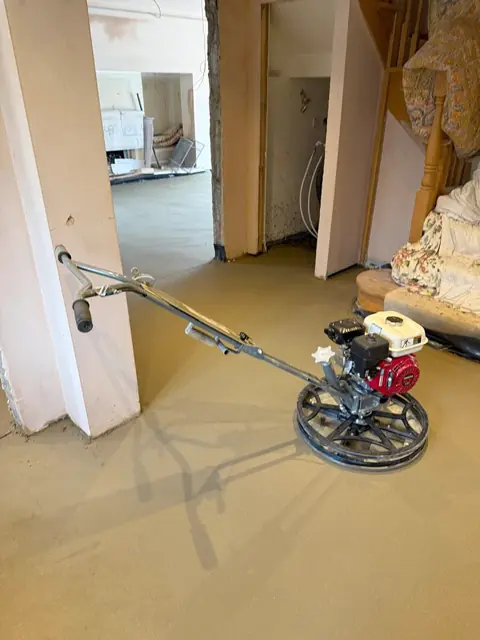
- Ruling off and closing the surface with a trowel or power float once compacted, as in the photo above.
- Curing. The MPA advises covering with plastic sheeting or similar for at least five days; Cemex's FAQs recommend at least seven days under polythene for traditional screeds.
Additives, fibres and when a factory mix is safer
The MPA notes that the majority of cement and sand levelling screeds contain an admixture as well as cement and sand. Fibres and quick drying binders are the other common additions. In practice:
- Polypropylene fibres help most on floating screeds and over underfloor heating. They reduce shrinkage cracking but do not replace compaction or depth. See fibre reinforced screed. Trade2base (June 2026) puts fibres at about £1 to £3 per m² extra.
- Rapid drying binders follow their own ratio and water limits, as the ARDEX example shows.
- Factory made screed removes the ratio question. MPA Mortar lists accurate cement content and consistent finished strength as the benefits of factory production, and Cemex says its retarded Readyscreed stays usable for one working day. Our guide to ready mix screed covers ordering it.
For cost, MyJobQuote (updated August 2026) puts traditional screed at about £18 to £25 per m² supplied and laid, and trade2base gives about £12 to £18 per m² for a bonded screed, excluding VAT. If you are weighing up doing a small area yourself, our guide to whether you can screed a floor yourself covers the tools and steps.
Safety with cement
HSE warns that wet cement trapped against the skin can cause serious burns, and that cement causes dermatitis. It advises waterproof gloves tested for alkalis, knee pads or knee boards when screeding, with waterproof trousers when kneeling, and washing cement off skin as soon as possible. It also suggests using pre-mixed products to avoid exposure to cement powder during mixing.
Get a fixed price for your floor
If the floor matters, send us the size and build-up and we will lay it at the right mix and compaction for a fixed price. To quote accurately we need:
- The area in m², or a sketch with room sizes.
- The depth available, from the slab or insulation to finished floor level.
- The construction: bonded to a slab, on a membrane, over insulation or over underfloor heating.
- What goes on top: tiles, LVT, wood, carpet or a commercial finish.
- The postcode and any access limits.
Send us the details or call 07466 650936. We call back the same day, send a written quote within 24 hours and agree a fixed price before any work starts.
Sources
- Mortar data sheet 22: Screeds, Issue 3, Mineral Products Association, October 2023, accessed September 2026
- Screeds, MPA Mortar, accessed September 2026
- BS 8204-1:2003+A1:2009, concrete bases and cementitious levelling screeds, BSI, accessed September 2026
- ARDEX A 38 ultra rapid drying screed cement, ARDEX UK, accessed September 2026
- Screed FAQs, Cemex UK, accessed September 2026
- Readyscreed traditional sand and cement floor screed, Cemex UK, accessed September 2026
- Cement: health risks and precautions, HSE, accessed September 2026
- Floor screeding cost guide, MyJobQuote, updated August 2026
- Floor screed costs UK, trade2base, June 2026